
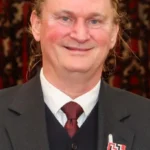
Dr Christopher Longhurst KSO.
Michelangelo’s famous frescoes in the Vatican’s Sistine Chapel were never just about
religion.
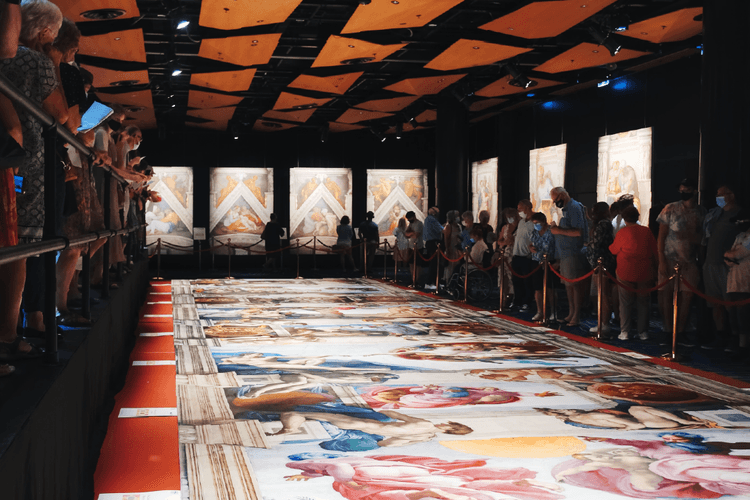
Yet while I was leading tours of Michelangelo: A Different View at Wellington’s
Tākina last summer, I was struck by how many people told me that friends and family had
skipped the exhibition because they assumed it was “just religious art.”
They couldn’t have been more mistaken.
I have come to think it is almost a polite fiction to keep calling Michelangelo’s Sistine Chapel
masterpieces “religious art.” The label may reassure some and tame the imagery for others,
but it ultimately diminishes one of the most provocative artistic visions in Western history.
To describe these frescoes simply as “religious art” is, in my view, an intellectual shortcut.
The label is tidy, reassuring, and convenient, but ultimately evasive. It substitutes a category
for an interpretation, reducing one of history’s greatest artistic achievements to the subject
matter it depicts rather than the profound questions it asks.
After spending more than two decades studying and interpreting Michelangelo’s frescoes
while working as a museum educator at the Vatican Museums—I have often been struck by
how differently people encounter these masterpieces once they move beyond the
assumption that they are simply “religious art.”
Granted, they were commissioned by a pope and depict scenes from Genesis and the Last
Judgment. But that tells us only who commissioned them and the biblical narratives
Michelangelo used to frame his ideas. It tells us little about what he was actually saying.
The irony is, Michelangelo wasn’t rejecting religion. He was destabilising it from within by
expanding it beyond immediate recognition. That’s why the clergy reacted so brutally. They
sensed something was slipping out of their control, even when they couldn’t articulate what
that was.
Michelangelo used religious imagery as a vehicle, not an endpoint. His art in the papal
chapel is transgressively human. He didn’t just depict human and divine encounter. He
advanced the idea of what it means to be human and “an image of God” beyond religion’s
expected boundaries.
Moreover, he painted unlike any of his contemporaries. His new understanding of anatomy,
informed by his mastery as a sculptor, his dynamic twisting figures, monumental scale,
luminous colour, and fearless celebration of the human body transformed the visual
language of Italy’s Renaissance, astonishing some viewers and scandalising others.
So what happens when we stop asking what his artwork teaches us about God and instead
ask how it illuminates the mystery of being human? Once we make that shift, we don’t
merely change the question—we reorient our understanding of the artwork itself.
This reframing does more than inform. It unsettles. Perhaps that was Michelangelo’s
purpose. Rather than simply illustrating religious doctrine, he reimagined the human person
and humanity’s place within the cosmos.
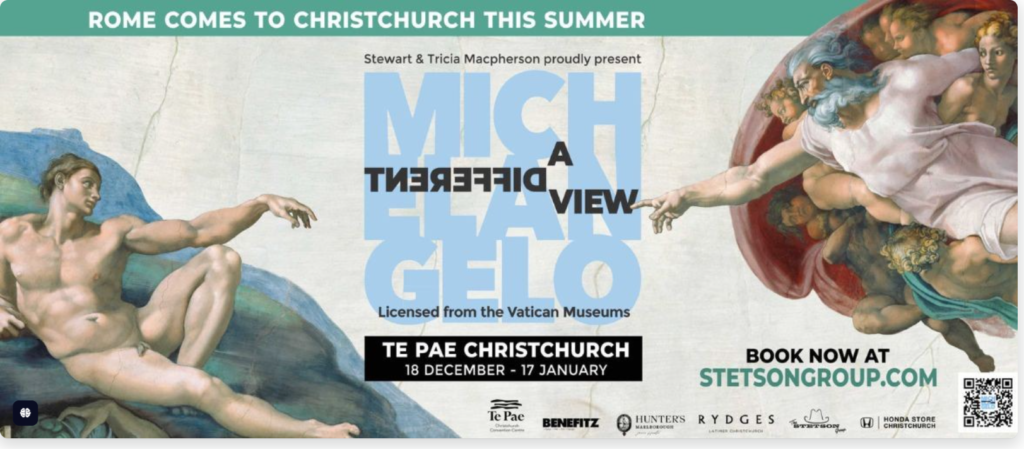
Looking closely, he presented God as a Sky-Father, not enthroned and untouchable but
dynamic, reaching towards the human with energy and resolve. The human, by contrast, is passive yet fully alive, eyes wide open, poised to receive the breath of life, and embedded in
the outer form of a woman.
The space between God and the human matters as much as the figures themselves. That
charged gap—filled with tension, expectation, and possibility—defines the moment.
Michelangelo is doing more than illustrating doctrine. He is exploring the mystery of what it
means for the human to be like God in relation to the cosmos.
His figures are unapologetically embodied. They twist, flex, recline, and surge with
extraordinary vitality. Muscles ripple where convention might have preferred restraint. Flesh
is not hidden. It is celebrated as the very medium through which the human and the divine
encounter one another.
It is here that many clergy and religious viewers have recoiled—disturbed by the nudity, the
heroic scale of the human form, and what they perceived as an unsettling blurring of the
sacred and the profane.
Perhaps Michelangelo’s greatest offence was not painting naked human bodies, but daring
to place them so intimately alongside the divine. In doing so, he challenged the assumption
that the sacred could be contained by artistic decorum or institutional control.
Rather, his frescoes suggest that the sacred is encountered most profoundly in the human
person—through the body, through struggle, and through relationship. Far from rejecting the
sacred, Michelangelo broadens our understanding of where it may be encountered.
Viewed in this light, his vision resonates in surprising ways with indigenous thought. His
depiction of creation echoes aspects of Mātauranga, where creation is understood not
merely as a past event but as the emergence of relationship through separation.
In a sixteenth-century Italian fresco, we glimpse an unexpected resonance with Ranginui
and Papatūānuku, whose separation gives rise to the world. The resonance lies not in the
stories themselves but in the way both traditions imagine creation—not as a distant act of
command, but as the emergence of life through relationship between earth, the heavens,
and humanity.
The image invites a surprising conversation across cultures, not least because the human
and the divine never actually touch. The narrow gap between them is deliberate. It is a
space charged with possibility rather than absence.
Michelangelo’s outstretched arms evoke the moment of birth itself. Like a child separated
from its mother as the umbilical cord is cut, the image speaks simultaneously of connection
and separation, dependence and independence. In both Michelangelo’s vision and
Mātauranga, creation emerges not through isolation but through relationship, and
relationship itself is made possible by separation.
This is only one layer of the fresco’s astonishing symbolism. Many scholars have
demonstrated that the mantle surrounding God is shaped like the human brain, while others
have identified further anatomical and metaphorical motifs woven throughout the
composition.
Every interpretation points towards a remarkable vision of the human person not as a
finished creation, but as consciousness awakening to itself, to relationship, and to the
limitless possibilities of human existence.
But some still approach Michelangelo expecting little more than religious illustration. In doing
so, they risk overlooking an artist whose genius lay not simply in depicting biblical stories,
but in revealing the profound mystery of what it means to be human.
Fortunately, those who missed the Michelangelo: A Different View at Wellington’s Tākina last
summer will have another opportunity to see it when the exhibition returns to Christchurch’s
Te Pae this summer. The Christchurch exhibition will once again offer us an opportunity to
discover just how relevant—and how cross-cultural—Michelangelo’s vision remains.
Encountering these masterpieces outside the Vatican invites us to see them afresh, freed
from the institutional framing that has too often confined them to the category of “religious
art.” The VIP tours with me will allow us to understand that Michelangelo was not merely
illustrating religious doctrine, but interrogating existence itself, pushing beyond the
constraints of ecclesiastical expectation to articulate something at once more universal and
more unsettling: that the sacred is encountered most profoundly in the mystery of the
human.
In sum, Michelangelo clearly painted beyond the expectations of his own age. Five centuries
later, his artwork still refuses to be confined by the label of “religious art,” because his true
subject was never religion. It was humanity.
Advertisement.