



Opinion: Noah Meagher
AI is undoubtedly a big deal in the world of education. Many schools are introducing AI curricula to help students engage with these new technologies – and rightly so. But those conversations need to run alongside a deeper one: what is education actually for?
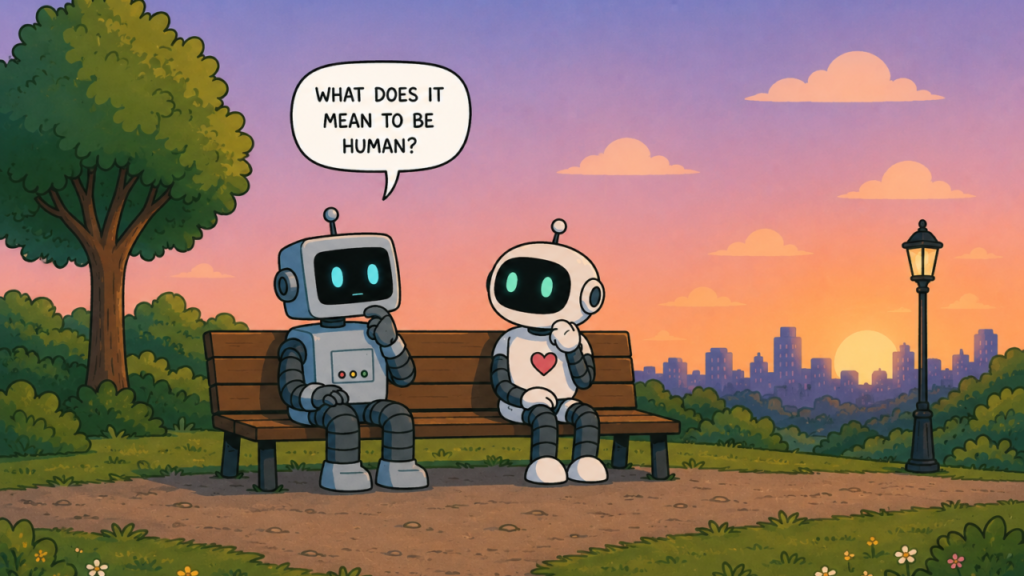
Education has long been justified by its economic utility and its preparation of students for productive participation in society. But as AI encroaches on that utility, we must ask whether such a justification was ever truly sufficient. If a machine can outperform humans on most cognitive tasks, then an education built primarily on knowledge transfer and measurable output can no longer suffice. As AI displaces functions we once considered ‘human’, we find ourselves pushed toward questions that are older and more fundamental: What is a human being? What are we for?
The book of Genesis answers that humans are made in the image of God – imago dei (Gen 1:27). Not an image merely in our ability to process information or produce outputs, but – as the broader biblical narrative makes clear – in our capacity for relationship, moral agency, creativity, and worship, and in our calling to steward creation wisely. These are not features of intelligence. They are features of personhood.
Paul’s vision of maturity in Ephesians 4 is not a person who knows more – it’s a person who is becoming more: growing into the “whole measure of the fullness of Christ.” Formation, not information. Character, not competency.
AI can generate wisdom-sounding content. It cannot become wise. It can describe love. It cannot love. It can model virtue. It cannot be virtuous. The moment you name what education is actually trying to produce – a person of integrity, courage, compassion, and faith – you’ve named something entirely beyond what any algorithm can touch.
This is the older and deeper tradition of education. Aristotle called it paideia – the formation of the whole person through immersion in a culture of virtue. Augustine spoke of rightly-ordered loves: the idea that good character is less about knowing the right answers than about wanting the right things. The Reformers framed it as wisdom for life coram Deo – lived consciously before the face of God. Different vocabularies, one conviction: as educators our role is not merely to fill minds. We are in the business of shaping people. Habits, loves, loyalties, character.
This is why disciplines that ask the hard questions – What is a human being? What does a good life look like? What do we owe each other? – are not peripheral to modern schooling. Call me biased – but subjects such as Theology and Philosophy, really are more relevant than ever. At their best – subjects that discuss these big questions of life – don’t just introduce students to these questions; they train students to inhabit them – to bring moral seriousness, theological imagination, and philosophical rigour to the decisions that will define their lives.
I’m still thinking this through myself, and am interested in hearing other perspectives. However, I really do believe that in this modern age, the schools that will serve students best are not the ones with the best technology strategy or AI curricula. They are the ones with the clearest answer to the question AI cannot answer for us: Who are we? And what are we becoming?
About the Author: Noah Meagher is Secondary Theology and Philosophy Teacher based in the Waikato