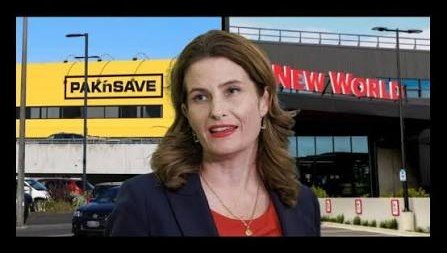




(cvnznews.com editorial note: Qiulae Wong referred to in this opinion piece is also known as “Q” and is the leader of the Opportunities Party.)
Opinion: Natalia Albert.
Peters has turned into a pantomime villain, the man who turned up to the COVID protest camp and who has been accused of betraying every political ally he has ever had.
Peters is also a political phenomenon: the politician who, across ten MMP elections, built and rebuilt a position of genuine cross-bloc leverage, deciding the shape of three governments and nearly two more. He is both, but today I will address the latter.
The version of Peters that has a very effective blueprint. And it is worth being precise about what that blueprint requires because the commentary around the Opportunity Party keeps blurring the difference between resembling a kingmaker and actually being one. Because love him or loathe him, he’s got his foot on our politics’ necks.

 Laine Cooper on Unsplash
The Peters model, properly understood
You do not become a kingmaker by announcing you will work with either side. You become one by building the structural conditions that make that announcement credible. There are four of them.
First, an electorate seat. Peters survived the 1999 election on a margin of 63 votes in Tauranga. NZ First’s party vote had collapsed to 4.3%, well below the 5% threshold, after voters punished the party for going with National in 1996. The electorate lifeline rule kept him in parliament. Without Tauranga, Peters is a footnote. The seat was structural insurance: it meant his party could survive a party-vote collapse and live to fight another day. He spent the following decade treating that seat as his personal property, and his voters knew it.
Second, a voter base whose loyalty seems personal. NZ First voters follow Peters, not NZ First.
Third, a voter base with genuine cross-bloc origins. Peters’ signature issues, immigration restriction and economic nationalism, are right-coded. But his anti-establishment populism and interventionist economic nationalism gave him reach into Labour-leaning provincial and Māori voters who felt left behind by urban-centred policymaking, while his cultural conservatism kept him credible with National. NZ First voters placed themselves near the centre on most scales, which is part of why the party fits poorly into standard radical right categories. Their economics were interventionist enough to do business with Labour. Their cultural conservatism was credible enough to do business with National. That dual legibility was structural.
Fourth, demonstrate willingness to go the other way. In 1996, Peters went with National. In 2005, he supported Helen Clark’s Labour government as Foreign Minister outside cabinet. In 2017, Labour again, this time in coalition with Ardern. In 2023, back to national. His credibility as a swing actor came precisely from having made each of those calls. A party that has only ever gone one way is not a kingmaker. It is a reliable coalition partner, which is a much weaker negotiating position.
Where Wong sits against that blueprint
She has none, yet!
She is standing in Mt Albert, where Labour’s Helen White held on by 18 votes in 2023, the slimmest margin of that election. If Wong wins it, she has her electorate insurance. That is a genuine possibility, though she has been publicly realistic about the odds. The seat is tight enough that it is not fantasy. It is also the one part of the blueprint she could plausibly achieve in the next six months.
Everything else is further away.
Opportunity’s voter base is concentrated in the progressive, urban, highly educated demographic that also considers voting Green or Labour. These are not voters with cross-bloc loyalty. They are left-leaning voters who are temporarily frustrated with Labour and looking for somewhere to park their vote. That is a real political constituency, and it is worth having. But it is not the same as Peters’ base, and it will not hold if Wong goes right.
The policy identity problem is real and has been real since the party was founded. Commentary going back to 2017 has noted the same contradiction: Opportunity wants to be both a Wellington policy-wonk party and a down-to-earth outsider party for people sick of the establishment. It cannot be both, and the tension has never been resolved. Neither of those identities is cross-coded in the way Peters’ issues were. Climate commitments and tax reform are left-coded. They attract centre-left voters. They do not attract the kind of National-leaning voter who might consider swinging to a third party if the policy offer were right.
And Wong has never gone right. It may be entirely deliberate, and it may be the right call for building the party in 2026. But it means that the “work with either side” framing is, at this point, a positioning statement rather than a demonstrated capacity. National’s strategists know that. Labour’s strategists know that too, which is part of why they are not panicking. A party that can only credibly go one way is not a kingmaker. It is a lever.
What Opportunity’s strategy actually is
Wong’s team have been clear about their model.
Opportunity is explicitly chasing the party vote. Their stated target is 150,000 votes to clear 5%. They are standing in over 30 electorates, not to win seats outright but to build local presence and visibility for the party’s vote. Wong is realistic about Mt Albert. The strategy does not depend on the electorate’s lifeboat. It is an all-in 5% play.
The framing they use for this is “teal”. They describe themselves explicitly as centrist, bridging Labour and the Greens on the environment and National on the economy. The pitch to voters is a version of “Keep Labour honest on the economy, keep National honest on the environment, and keep the extremes out of Cabinet.” It is designed to sound cross-bloc, and in the right political environment, it could attract voters from both sides. The problem is that their actual strategy does not match their positioning.
The teal model they are borrowing from is the Australian one, where independent candidates won specific seats in blue-green electorates where moderate Liberal incumbents were vulnerable to a cross-party environmental challenge. Those wins were built on individual candidates with strong local credibility in specific communities. They were seat wins, not party vote wins. Translating that model into a New Zealand MMP context requires something the Australian teals did not need: a party vote base that genuinely spans left and right.
Look at who Opportunity is actually targeting. Their demographic is young people, students, first-time voters, and under-30 professionals frustrated with the status quo. Their named funders are AJ Wilderland, co-founder of Serato; and Philip Mills, founder of Les Mills International, both with strong sustainability and climate focuses. Their headline policies include a land value tax and a citizen’s income alongside climate action and affordable housing. These are not cross-coded signals. They are left-coded signals with a centrist wrapper.
None of this is a criticism of the policies. A land value tax is good policy. So is a UBI-style citizen’s income, if any party manages to do actual tax-reform policy. But a voter in Tauranga or Tāmaki who might once have parked their vote with NZ First is not looking at that policy suite and thinking “this is my party.” Opportunity’s actual voter base is progressive voters who are dissatisfied with Labour and the Greens, not National voters looking for a more environmentally credible home. That is a real constituency. But it is not the cross-bloc base the kingmaker claim requires.
Peters’ leverage in 2017 and 2023 was credible because National genuinely did not know which way he would go, because his voters genuinely did not know either, and because his policy identity gave him structural reach in both directions. Opportunity’s funders, demographics, and policy suite tell a coherent story, but it is a story about a progressive minor party with a centrist brand, not a genuinely cross-bloc actor. The “keep National honest on the environment” line sounds like leverage. It is only leverage if National believes Wong can credibly walk away from a Labour deal and go right. Nothing in the current strategy suggests she can.
What Wong would actually need to do
To replicate the Peters model, Wong would need to either extend the timeline or compress the requirements. Extending the timeline means accepting that 2026 is a building election, winning Mt Albert, getting a toehold in Parliament, and spending the next three to six years deliberately cultivating a cross-coded voter base and policy identity before the real kingmaker play is available. That is the honest version of the strategy, and it has internal coherence.
Compressing the requirements is harder. To arrive at November with genuine cross-bloc leverage, Wong would need to do something that demonstrably costs her with her current voter base but gains her on the other side. That could be a specific policy position that draws right-leaning environmentally-minded voters, the kind of voter who used to park with National’s blue-green wing before the current government made that impossible. It could be a concrete signal that she is willing to give National something real in exchange for something real. It would need to be credible enough that National’s strategists start thinking about whether there is a deal to be had.
None of that is currently happening. The campaign is well-funded; Iain Lees-Galloway running the operation as general manager is a good appointment. The $500,000 war chest are real money by the party’s historical standards. But the structural requirements for kingmaker status are not fundraising requirements. They are voter-base and policy-identity requirements, and those take longer to build than a campaign cycle.
The wasted-vote trap and what it means for November
The more immediate question is whether Opportunity can break 5% at all. The wasted-vote trap is circular and well-documented: voters who like the party will not risk their vote on it if they do not believe it can win, which means it cannot win, which confirms their caution. Bryce Edwards, writing in The Democracy Project this week, puts Opportunity’s polling average for 2026 at around 2.3%, with a May 1News/Verian poll reaching 3.3%. Every party that has broken through into parliament under MMP has done so with a leader who was already a sitting MP.
On current polling, Labour is tracking between 34% and 37% depending on the pollster, which translates to roughly 42 to 46 seats. The Greens are around 11%, worth approximately 13 to 14 seats. Te Pāti Māori are at 2%, surviving on their electorate lifeline. That combination gets the left bloc to the government benches but without margin. A 5% Opportunity party sitting alongside Labour on confidence and supply changes that picture materially. A wasted 3% Opportunity vote drawn from the progressive end of the electorate does not come back to Labour. It disappears. That distinction matters, and it is why Labour’s current posture of deliberate distance from Opportunity is shortsighted even on pure electoral arithmetic. Assuming a wasted vote of around 5 to 6% from sub-threshold parties, Labour’s 34% gives them roughly 43 to 44 seats. At 37%, the figure rises to around 46. The assumption is worth stating because the seat count is sensitive to it.
The bottom line
Wong is not Winston Peters. Not yet and possibly not ever. The kingmaker model requires structural conditions that take years to build, and Opportunity has one of the four components at best. What Wong has is a genuine improvement on anything the party has previously managed, a serious campaign apparatus, and a political environment that is more favourable to a third-force insurgency than New Zealand has seen in a long time.
Whether that is enough to get to 5% in November is genuinely uncertain. Whether it is enough to be a kingmaker is a different question, and the answer is no, not this cycle.
The interesting question is what happens if Wong wins Mt Albert, holds 3-4% of the party vote, and ends up as a one-seat outlier in a parliament where the left bloc needs every bit of help it can get. That is not kingmaker territory. But it is leverage of a different kind. And it would set the party up for 2029 in a way that nothing else could.
That might be the play. If it is, it is worth being honest that it is a 2029 play, not a 2026 one.