

Meghna Bali, Bhat Burhan, and Neha Hirachan/ABC News
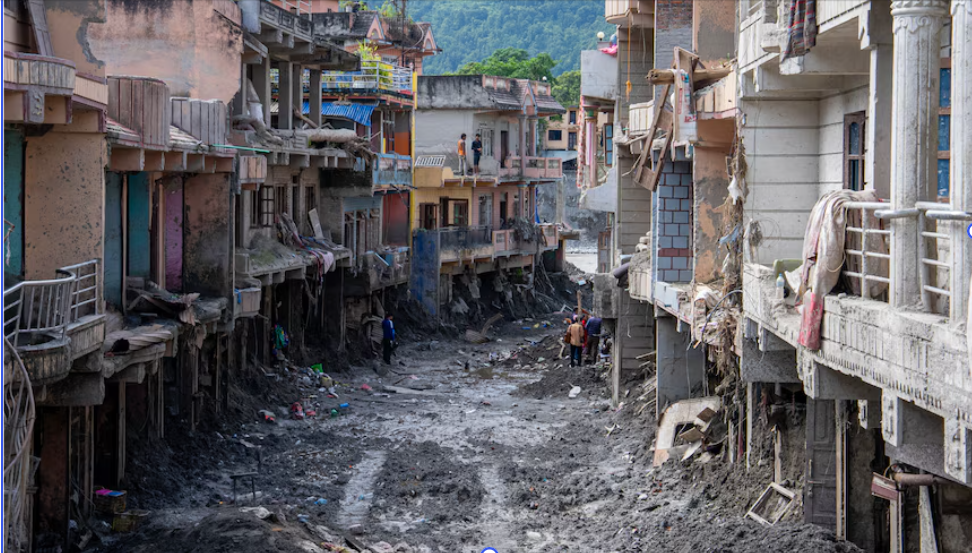
A month after catastrophic floods swept through Nepal’s Nuwakot district, the town of Devighat still smells of death.
Excavators continue to claw through vast layers of grey mud that swallowed homes, businesses and roads. As the earth is turned over, the smell of decay rises again.
From above, entire sections of the town appear to have been erased.Nepal rescue efforts head to the skies
A desperate Australian family charters a helicopter to fly over the Nepal-Tibet disaster zone to search for missing loved ones.
The Trishuli River runs beside a landscape of sludge, broken concrete and twisted metal. Some homes remain standing but are buried through their lower floors. Others have disappeared altogether.
The August disaster began when a massive collapse of ice and rock in the Himalayas sent a torrent through the Bhotekoshi and Trishuli river systems, devastating communities on both sides of the Nepal-Tibet border.
More than 1,400 people have been killed and more than 5,700 remain missing, including 34 Australians.
A town still buried
Maina Pariyar keeps returning to the patch of mud where her house once stood.
She lived there for more than 35 years and raised eight children. Now there is little to show that those decades of family life took place.
“I spent so much time, energy and money building my house … all our lifelong hard work is gone,” Ms Pariyar said.
“We could not even find a spoon from our house.”
Ms Pariyar walks slowly through what remains of the neighbourhood, pointing towards places that are no longer recognisable.
The flood stripped families of almost everything they owned. But for many, leaving permanently feels almost as difficult.
Ms Pariyar now sleeps in a small tent in a relief camp about 10 minutes from her old home. Her few remaining possessions fit inside.
Days are structured around basic needs — collecting water, keeping the tent clean, lining up for meals and clearing grass around the shelters.
Ms Pariyar’s children have asked her to move to Kathmandu. She has refused.
“This is the place where I was born. I don’t want to leave my roots,” she said.
“If I am nearby, at least I would be able to come and see my place.”
Even the temporary camp brings little sense of security. Ms Pariyar worries about further rain and what would happen if the river rose again at night.
“If the flood comes during the day, I can still manage to run and save my life. But if it comes at night, how do we even run?” she said.
“There is no safety anywhere, and our lives are safe nowhere.”
Relief is not recovery
Aid poured into the region the immediate aftermath of the disaster.
A Nepal Scout official working in the Bidur and Devighat area said teams had distributed supplies, recovered bodies, helped children return to school and travelled by road and helicopter to communities that were difficult to reach.
But a month later the surge is slowing.
“There were too many efforts then, but right now, it’s slowing down,” he said.
Food, clothes and basic supplies are still being delivered, but Nepal’s finance minister has said the country would need $US4-5 billion to properly rebuild.
The government is seeking $US20 million from the United Nation’s loss and damage fund, which was created to provide financial assistance to developing countries impacted by climate change.
But what survivors increasingly want is an answer to a much bigger question: where are they supposed to live?
Parbat Sharma regularly returns to his family’s damaged home.
Six ground-floor rooms were destroyed and thick debris remains inside the first floor. The area has since been declared a red zone, leaving him unsure whether repairing the property would be safe, or even permitted.
“If I spend money rebuilding my house here and the government does not allow me to stay, then who will bear that cost again?” Mr Sharma said.
“I think what we need right now is a decision from the Nepal government to tell us whether we can live here in the future or not.”
He has spent weeks living between damaged buildings and temporary accommodation.
“Sometimes, I sleep on the floor, sometimes I’m just around,” Mr Sharma said.
“At night, I wait for the morning. I hope nobody goes through this.”
Survivors in Devighat have spent a month without knowing what is coming next. Thousands of kilometres away, others are also living in uncertainty.
A different kind of waiting
At her parents’ home in Sydney, Vaishnavi Kowshikan opens a laptop and zooms in on a map of the Nepal-Tibet border.
She points to the area where her sister Shylaja Muralitharan, her brother-in-law and their two sons were last believed to have been. All four remain missing.
The photographs from the days before the flood show a family on a mission: taking part in religious prayers, climbing through spectacular mountain landscapes and making their way along the Kailash Mansarovar pilgrimage.
Now those images are part of a painstaking effort to reconstruct where they went and what may have happened next.
“The fact it’s been four weeks is something I can’t myself come to terms with,”
Ms Kowshikan said.
“It’s stagnant because nothing’s changed. We’re living in that same space that they’re missing and there is no further information.”
Ms Kowshikan regularly checks WhatsApp groups and Facebook posts, scans survivor lists and tries different combinations of her relatives’ names in databases.
Sometimes she types only part of a surname, hoping a spelling difference might uncover something missed before. The result is always the same: “no rescue records found.”
Ms Koshikan is constantly worrying about whether the Nepali authorities have missed a spot her family could be in. She is especially concerned about her two nephews, 14-year-old Ashwin and 11-year-old Aarush.
“If there’s some people who are there that are unconscious or unidentified or unable to speak up for themselves to say, ‘This is who I am’, has that been checked?” she said.
As the weeks have worn on the stream of information has become thinner while the family’s need for certainty has grown.
In Devighat, survivors can at least return to the places where their homes once stood.
For Ms Kowshikan, the landscape exists largely through satellite images, maps, photographs and fragments of information.
Her parents are too distressed to speak publicly.
Ms Kowshikan has been doing much of the searching and led the effort to keep her missing family visible.
“With not having [Shylaja] here, it’s like one third of me is missing,” she said.
“How do I navigate now until I can find her again?”
A month after the floods, it is a question thousands of families across the world are still trying to answer.