



OPINION: Michael Swanson.
Thoughts, feelings and predictions that have a high likelihood of ending up completely wrong
At this point in the election cycle, we get to the point where people really start to scrutinise and make calls on the final result – so that is exactly what I’m going to do here. I’ve already made a few comments in other places about certain potential results, but in this I’ll probably tweak a few of those as I’ve refined my thinking.
Call it what you will – vibes, feels, gut instinct – I’m going to make predictions based much less on any sort of science, and more a combination of what I’ve read combined with my own gut feeling around all of this. Take much of this with a grain of salt, but I figured that If I’m going to walk around giving out an opinion on various seats and results then I should put them down in writing, if only to come back and laugh at how wrong I was later on.
The Impact of Vote Splitting
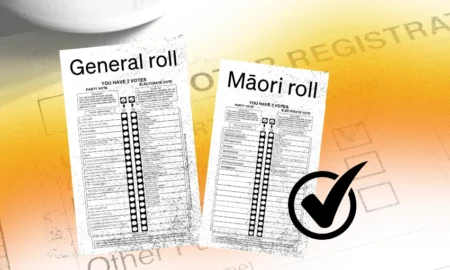
Two different “vote splitting” pushes are running in the lead-up to the 7 November election, and both exploit the fact that MMP gives each voter two votes. On the left, Te Pāti Māori is urging supporters to back its candidates with their electorate vote while giving their party vote to Labour, the Greens or another left-wing party. The aim is to win more Māori electorates while using the party vote to strengthen the wider left bloc. If it works, it could produce an overhang, where Parliament grows beyond its usual 120 members.
On the right, some commentators and campaign sites are urging National supporters to give their electorate vote to National but their party vote to ACT or NZ First, on the theory that this elects more coalition MPs overall. John Key has called that advice “misguided”, while others, such as Maurice Williamson, suggest National voters strategically give their party vote to ACT or New Zealand First to maximise the right-wing seat count. I’ve written about this previously, laying out how the campaign developed and who was behind the initial push to do it, so go and have a read of that for a deeper dive.
The real effect is hard to predict because it depends on how many voters actually follow the advice, and there’s little evidence yet. Even within the Te Pāti Māori campaign, Labour and the Greens are still running their own candidates in the Māori electorates, and the party itself is dealing with internal turmoil, including a split in Te Tai Tokerau that has opened up the race there. Political scientist Lara Greaves has noted that Te Pāti Māori’s party vote has mostly either created an overhang or hasn’t necessarily advantaged them, so the benefit isn’t guaranteed. There is also a lot of disagreement on cause and effect. One piece argues the Greens’ rise among Māori voters is partly down to this strategy, but that there is more at play.
The wider picture is uncertain too: polls point to a possible hung Parliament, and there’s a pretty high undecided vote (anywhere from 10-25% depending on the poll). With the margin that tight, a small shift in a few electorates or in the party-vote split could matter a lot, and we won’t know whether it did until the votes are counted.
Unknown unknowns
Publishing this a week before the final result is a bit of a risk – any number of things could happen between now and 7pm on 7 November. Politicians (and especially aspiring ones) are very good at making horrendous mistakes that change the course of an election. There is still plenty of time for someone to have an absolute trainwreck of an interview, do something illegal, or just generally create a problem so significant that it changes the course of the election.
The other thing that has happened before is the death of a candidate. It’s quite a morbid thing to raise, but in 2023 this resulted in an extra seat in Parliament after the death of the ACT candidate for Port Waikato. As a result, a by-election was required for the electorate seat which was added to Parliament at a later date. If a similar thing was to happen on the next week during this election that extra seat could have a reasonable impact on the overhang that I think will already exist.
This is always one of the warnings for early voters – one you make a decision, you can’t undo it. For the record, I like the advance voting option, but I’m a bit of a traditionalist – I leave my vote until the day (unless for some reason I need to do it earlier) even if my mind is already made up, because I have a little voice in the back of my head saying “just wait, someone could still cock this whole thing up”.
Prediction Time
I’m going to do this in two parts. Firstly, I’m going to look at a few electorates that I think might go a bit differently to the way most people are thinking – I’m going to touch on a few electorates that have really interesting races and may be impacted by vote splitting in a way that raises a few eyebrows. Secondly I’m going big picture – party vote, overall percentages, seats in Parliament – I’ll look at how I think each party will perform overall, who might be in and out, what that means for Parliament as a whole.
Electorate Races
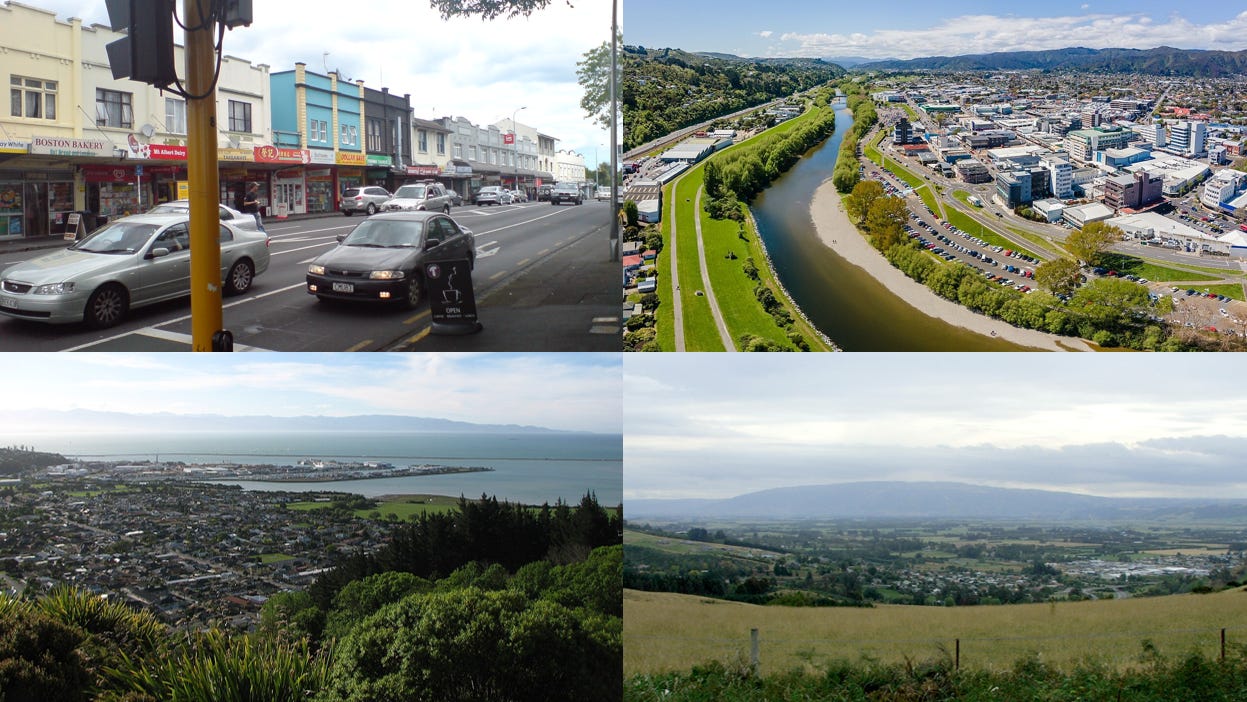
I have already written a reasonably extensive piece on electorates worth watching, so go and have a read of that here. But I’ve picked out four that I think will go differently to the way people imagine, or will have a really significant impact. So here are some takes, some of which people might find a little wild.
Mount Albert – Melissa Lee to become the MP for Mount Albert? I think she might be…accidentally. Helen White won Mount Albert in 2023 by a whopping 18 votes from Melissa Lee, and in 2026 I think the Labour/Greens split, coupled with a little vote splitting could tip things Lee’s way. Throw into the mix Opportunity Leader Qiulae Wong, and there is a real recipe for an upset in the mixer. This would be a major, major upset – Mount Albert is the home of Helen Clark, David Shearer, and Jacinda Ardern – it’s a Labour stronghold. But my gut feels like something weird is about to happen, and Melissa Lee will be back on deck for another term.
Hutt South – There seems to be a lot of confidence from Labour in Hutt South (maybe not from Ginny Anderson, though), and I think they might be onto something. Hutt South is one electorate where I think both sides have got the message – it’s a Red versus Blue shootout, so pick your poison. Changes to the electorate have changed the nature of the electorate to make it slightly more Labour leaning, and if there is a concerted effort to displace Chris Bishop by voting for Ginny Anderson, this could very well happen. Bishop won the electorate in 2023 by 1300 votes, but I think this might evaporate quickly. My pick – I think this could end up as one of the closest results on the night, but will tip Labour’s way.
Nelson – About a month ago I spoke to the Nelson Mail about bellwether electorates, suburbs, and a few things to do with areas that can predict (or at least give insight into) election results. In that, and in an interview I did with the NZ Herald, I was asked whether I thought the result from 2023 would be different in 2026. For context, in 2023 the Labour candidate Rachel Boyack beat National candidate Blair Cameron by just 26 votes. In my conversations with the NZ Herald and Nelson Mail I said it would be close, but not quite that close again, and that I wasn’t sure Cameron could win it this time around – however as my thoughts around the vote splitting campaign have solidified, I’m now coming around to the idea Cameron might be able to pull it off. Much like other races, if this does happen, Nicola Willis will be crying into her martini at results like this (and the Mount Albert result).
Taieri – Taieri is a massively interesting race this time around, and I’m not the only one who thinks so. The change from Dunedin South to Taieri ahead of the 2020 electorate on the face of it looked like it would benefit the right – it brought in more rural areas that tend more towards the parties on the right. This however coincided with the red wave of that election and was dominated by Labour. Fast forward to 2023 and things got a lot closer. In 2026 the vote splitting tactics make this a fascinating race – if ACT and NZ First voters decide to follow this idea then it will make the contest between incumbent Labour MP Ingrid Leary, and National candidate Matthew French a very close one. I’m really hesitant to say this will flip, but I wouldn’t rule it out (the chance of a change is not insignificant), and I think this could be one that is too-close-to-call on the night.
Overall, I think the vote splitting campaign could have a real impact on electorate races, and some weird results may just spring up out of the ground that people weren’t expecting, but we really have no clue how it will play out until election night.
The Big Picture
Neck on the line – I think the current government (albeit balanced very differently, with some very different faces in the mix) will be returned on 7 November. But, how they do it will be a massive cause for concern and consternation. I’m picking a fairly substantial overhang which could mean that even if Opportunity get in they don’t sit in a kingmaker spot.
Below are my numbers that I’ve plugged into the MMP calculator. I have made some big calls – National to have a 6 seat overhang, Opportunity to get 8 seats, and Labour to lose some surprising seats. I had a great chat with Harry Alemy on his podcast The Almey Alternative (thanks to Otago Access Radio), and I’ve already changed one thing I said there – I had a better look at the Māori seats and instead of the 2 I thought TPM would win, I now reckon they’ll win 4. So here’s the numbers:
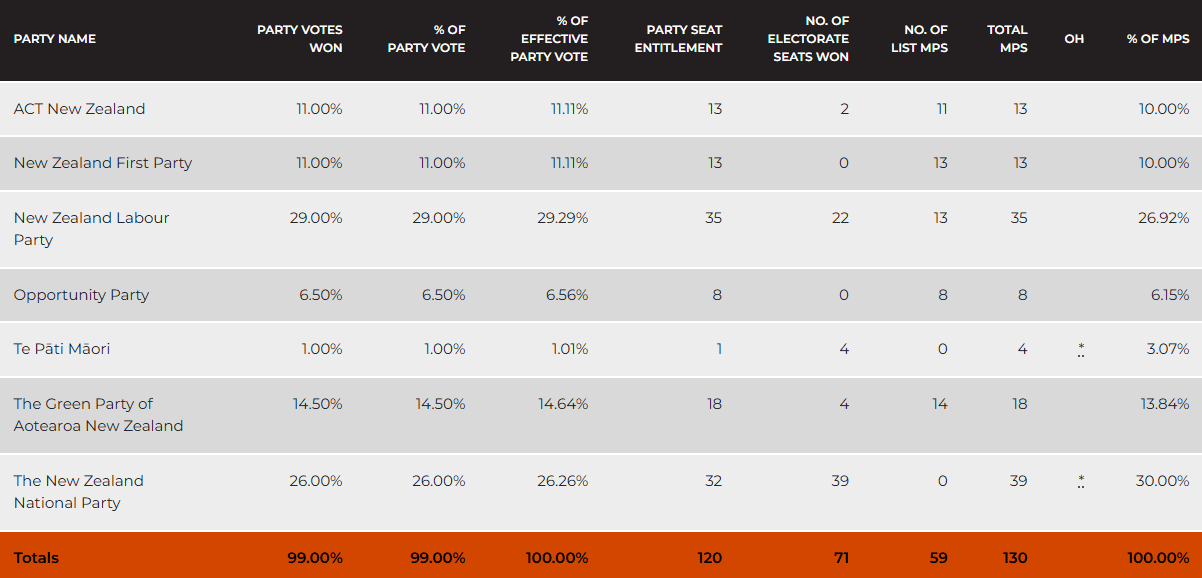
Here’s the run down, and I expect most people to hate it:
- National – 39 (with a big ol’ overhang)
- Labour – 35
- Greens – 18
- NZ First 13
- ACT – 13
- Opportunity – 8
- Te Pāti Māori – 4
- Total seats: 130
If my maths is correct, and it often isn’t, that could result in a hung Parliament. It would give the existing coalition 65 seats, and require them to work with Opportunity to get things done. The “left bloc” by contrast, even with Opportunity, wouldn’t have the numbers to get a majority in Parliament. I’m not saying I want this, nor am I saying I like this result, but when I did some blind predictions, these were the numbers I ended up with. Could be a real shit-show if my predictions occur.
The truth is, though, we just don’t know what the result will be until the night of 7 November arrives. People do weird things, and might not act in a way we would consider rational. As a result, we just don’t know how many will take up the split vote challenge – I could be right and we see a big overhang as a result, I could equally be horribly wrong and it just doesn’t play out that way. Either way the result will be tighter than most would probably like!