



Ashley Church
There’s a fascinating story in the Old Testament about a group of people who fooled Israel into making a peace agreement with them.
It happened during the period when Joshua was leading the Israelites back into Canaan after centuries of exile in Egypt and forty years in the wilderness. After the death of Moses Israel had already defeated several cities and the local peoples understood that a powerful new force had arrived in the region. Among them were the Gibeonites, who lived in a group of nearby towns and realised that if they simply waited for Israel to arrive, they could face destruction.
So they chose deception instead.
They dressed in worn clothes and old sandals, packed cracked wineskins and mouldy bread, and travelled to Joshua pretending they had come from a distant country. Their story was carefully constructed to make it appear that they lived far outside the territory Israel was taking possession of.
Then they asked for a treaty.
Everything about them appeared to support what they were saying – so Joshua and the Israelite leaders accepted the story and entered into an agreement with them.
Three days later, they discovered the truth. The Gibeonites weren’t foreigners from some distant land at all. They were neighbours. Israel had been deceived into making a treaty on the basis of a false picture of who the other party was and where they had come from.
The treaty still stood, because Israel had given its word, but the assumptions behind it did not.
And that’s the part of the story that matters here. What appeared to be true at the moment the agreement was made wasn’t actually true at all.
More than three thousand years later, Israel still faces the same problem. It has to think not only about what today’s agreements might mean in ten or twenty years, but sometimes about what may actually be happening right in front of its eyes.
That’s why a recent report from Israeli media is so interesting.
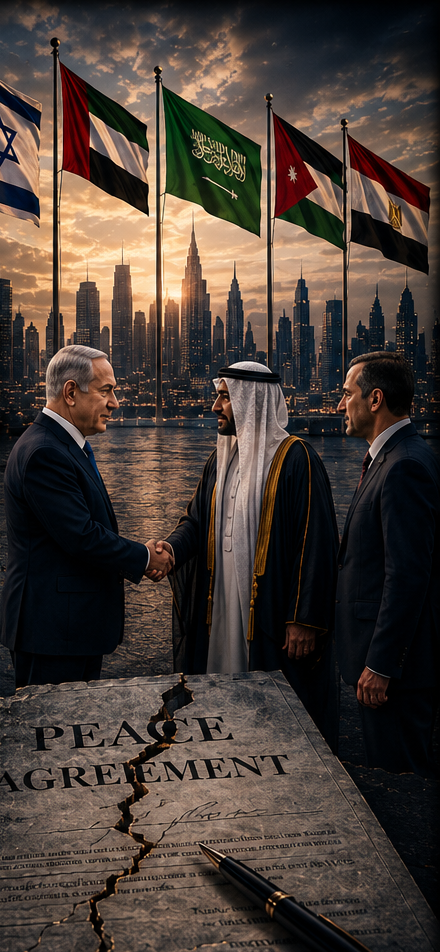
According to that report, officials from one unnamed Arab state have been urging another Arab country considering normalisation with Israel to treat any agreement as a tactical measure, creating a period of calm while preparations continued for a future attack.
If that’s true, the parallel with the Gibeonite story is striking – although there are some important caveats. The countries haven’t been identified so we don’t know whether either is part of the Abraham Accords or whether the advice was accepted – so it would be wrong to conclude that the Abraham Accords themselves are some elaborate deception, or that every Arab country seeking relations with Israel is acting in bad faith.

But the report does raise a much larger question: how does Israel know whether the peace being offered today reflects the strategic intentions of tomorrow?
And, just as importantly, how does it know whether the leadership offering that peace will even still be there in ten or twenty years?
History is littered with agreements which looked much better on the day that they were signed than they did years later.
In 1994, Ukraine gave up the nuclear weapons it had inherited from the Soviet Union in return for security assurances, including from Russia. Twenty years later Russia seized Crimea, and in 2022 it launched a full-scale invasion of Ukraine.
That same year, the United States reached an agreement with North Korea intended to freeze its nuclear programme. The agreement worked for a while – but now North Korea is now a nuclear-armed state.
And in 1993, Israeli and Palestinian leaders stood on the White House lawn celebrating the Oslo Accords, which were widely hailed as the beginning of a new era of peace. Within years, the process had collapsed into renewed violence.
None of those agreements necessarily looked foolish when they were signed. They were agreements for the circumstances of the moment.
The problem is that history doesn’t stand still.
Governments change. Leaders change. Strategic interests change. Enemies change tactics. And sometimes the people signing the agreement may not even share the same understanding of what the agreement is intended to achieve.
Which brings us to Donald Trump and the Middle East today. Trump has always been fascinated by the deal. He takes a highly transactional approach to politics and foreign affairs, and sometimes that has produced genuine results. The Abraham Accords were a significant achievement because they established formal relations between Israel and a number of Arab states which had previously refused to recognise it.
But there’s a difference between making a deal and permanently changing the strategic reality – and Israel has to live with whatever happens after any signing ceremony.
That distinction matters because the regional environment around Israel is becoming increasingly complicated. For example, the United States has now entered into an agreement to help Saudi Arabia to develop a civilian nuclear programme. The stated purpose of the programme is peaceful nuclear energy and there’s no evidence that the Saudis are currently seeking nuclear weapons – but that isn’t the only consideration for Israel. It must also consider who might control Saudi Arabia in ten, twenty or thirty years’ time. A nuclear programme built for peaceful purposes today will still leave behind infrastructure, expertise and capability tomorrow – and who knows who might be leading Saudi Arabia – or Iran – or Turkey – in 2040.
This is where Israel’s own strategic thinking becomes important and adds context to Netanyahu’s recently stated plans to progressively reduce Israeli dependence on American military assistance and dramatically expand its own domestic weapons production.
This doesn’t mean Israel is abandoning America. It is simply recognising that friendship and dependency aren’t the same thing. America may remain Israel’s closest ally. The Abraham Accords may endure. Saudi Arabia may even become an increasingly important regional partner.
But Israel cannot make its survival dependent on any of them.
That is the central strategic reality facing the Jewish state.
Israel can make peace wherever peace is possible. It can build alliances. It can cooperate with America. It can welcome moderation among Arab governments and pursue normalisation across the region.
But it also has to prepare for the possibility that today’s friends may not always be friends, today’s governments may not always govern, and today’s agreements may not survive the circumstances which produced them.
Most countries can survive a serious foreign-policy mistake.
Israel may not get that luxury.
The lesson of the Gibeonites wasn’t that Israel should never make agreements – it was that appearances can deceive.
And there’s another consideration. Anyone who reads Scripture and takes biblical prophecy seriously knows that whatever peace Israel may achieve with its neighbours, today, will not ultimately be permanent. One of the clearest recurring themes in prophecy is that Israel will once again face attack from the surrounding nations of the Middle East at some point in the future.
That doesn’t mean that present-day peace agreements are meaningless or insincere – but Scripture tells us they cannot be the final chapter. So while Israel should continue to pursue peace wherever it can, it must also prepare for the day when that peace ends. Whether its neighbours acknowledge that future or not, it is an eventuality Israel cannot afford to ignore….