



OPINION: Michael Swanson
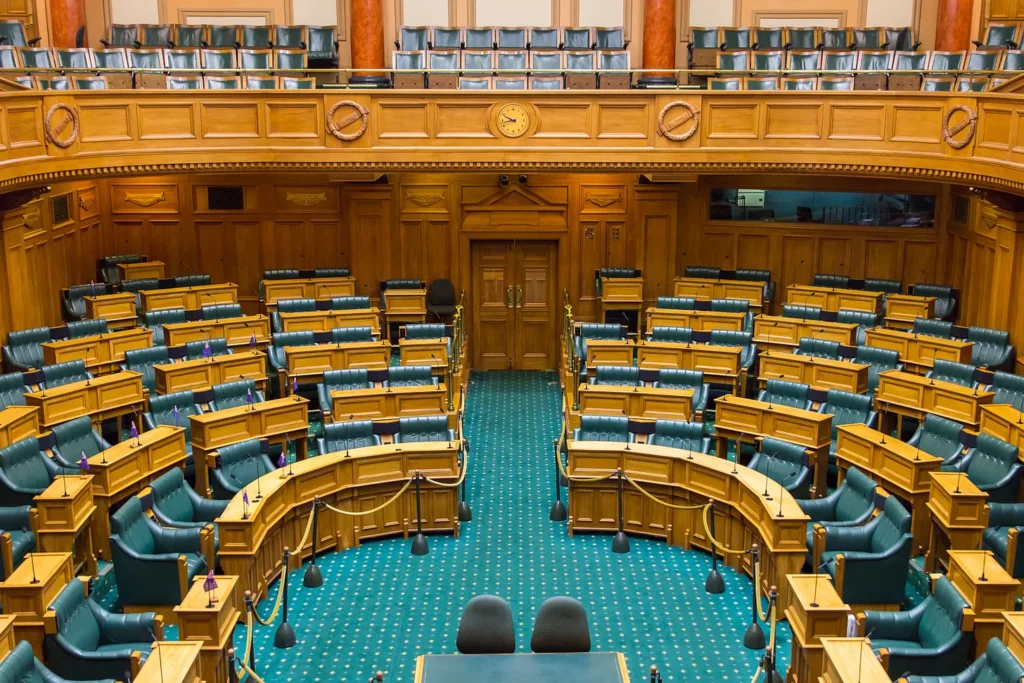
Every sitting day in the New Zealand Parliament, when a contested vote is called, MPs do not usually troop into division lobbies to be counted one by one. Instead, a single person from each party stands and calls out a number. That person is the party whip, and the number they call is not a suggestion.
It is, in effect, the whole party voting as one. For a country that prides itself on representative democracy, it is worth asking whether this system hands too much power to party managers at the expense of the individual MPs New Zealanders actually vote for.
What whips do
The whip is an old office, imported from Westminster and named after the “whipper-in”, the huntsman’s assistant who kept the hounds from straying off the pack. Every party with four or more MPs in Parliament is entitled to appoint at least one whip, with larger parties allowed two or three. Their formal job, as Parliament’s own explainer sets out, is wide-ranging: preparing speaking lists, making sure members are in the chamber and at select committees when needed, negotiating with other whips over House business, casting votes on behalf of the party, and helping settle disputes within caucus. If an MP wants to be absent, they need the whip’s approval first, and an unauthorised absence can bring internal discipline.
Not every party uses the traditional title. The Green Party calls its equivalent a “musterer” and Te Pāti Māori uses “matarau”, but the function is the same. As one former whip told RNZ’s The House, part of the job is pastoral, checking in on colleagues who are struggling, since Parliament “can be a very lonely place at times” for people who spend much of the week away from family. But the more consequential part of the role, as that same interview makes clear, is managing party performance in the debating chamber, since whips are responsible for casting the party vote on behalf of all their MPs.
How party voting actually works
The mechanism that gives whips their real power is called the party vote, introduced in 1996 to coincide with the first MMP election and modelled on a system of collective voting used in the Netherlands.
Under the old first-past-the-post Parliament, every contested vote required MPs to physically walk into “Ayes” or “Noes” lobbies to be counted. Under party voting, most contested votes are instead conducted as a block, with a party representative calling out a total on behalf of each recognised party, so that the party complexion of the House, as set by the party vote at the election, is reflected directly in its decisions.
Crucially, this is a default rather than an absolute command. The same official guide notes that a whip is entitled to presume a member’s vote is included in the party’s total unless that member takes the initiative to “contract out” of it, and that if a member wants to vote against their party after it has already voted at full strength, the inconsistency has to be resolved by the Speaker before the result can be declared. Any MP present in the parliamentary precinct, including at a select committee meeting or on approved official business, is automatically counted in their party’s total, and a limited number of proxy votes can cover MPs who are elsewhere altogether.
There is a genuine safety valve: the conscience vote. On matters such as euthanasia, abortion law or same-sex marriage, parties have traditionally released their MPs to vote as individuals, entering the lobbies exactly as MPs did before 1996. As RNZ’s explainer on conscience votes puts it, since MMP began, votes on bills are otherwise made by party blocks, with a whip from each party telling the Clerk the numbers.
What conscience votes don’t really cover are situations where a sitting electorate MP could be required to vote for something as part of the party vote that has direct negative implications for their electorate. One issue with the shift towards greater control over party voting is that it has diminished any independence electorate MPs may have once enjoyed, though this prior freedom is often overplayed.
Voting against your own party outside a conscience vote is what is still called “crossing the floor”, a phrase that survives from the days when doing so meant physically walking to the other side of the chamber. It remains vanishingly rare and career-defining: the same RNZ piece recalls that when Marilyn Waring crossed the floor in 1984 to support a ban on nuclear ship visits, the sitting Prime Minister called a snap election over it.

 https://www3.parliament.nz/mi/
The case that whips have too much power
Critics argue the party vote system, reinforced by MMP’s list seats, has hollowed out the independence Parliament is supposed to embody. A list MP owes their seat entirely to the party vote and their position on the party’s list, not to any personal mandate from a specific electorate, which critics say makes them acutely dependent on staying in their leadership’s good graces.
This argument found its sharpest expression in the fight over the “waka-jumping” law, which allows a party leader to trigger the expulsion of a defecting MP from Parliament altogether. A joint academic submission opposing the bill, reported by Newsroom in 2018, warned that “electoral integrity” legislation empowers party hierarchies to stifle debate within the party, using disciplinary procedures to force dissenting MPs not only out of the party but out of the House itself, and argued that healthy democracies can tolerate dissent.
The New Zealand Law Society raised similar constitutional concerns in its submission on the bill, stating publicly that it would significantly limit MPs’ rights of free speech and freedom of association by empowering party leaders to force MPs to vacate their seats. More broadly, as the New Zealand Herald’s political roundup noted, critics of the wider system point out that list MPs, unlike electorate MPs, cannot seek a fresh mandate through a by-election if they fall out with their party, removing an important check on the power concentrated in Parliament during a term.
The case for the current system
Defenders of party discipline argue it is not a flaw but the whole point of MMP. The system was explicitly designed to let the proportions New Zealanders vote for at an election translate directly into the decisions Parliament makes. If MPs voted as unpredictable individuals, that proportionality would be meaningless, and coalition and confidence-and-supply arrangements, the basis on which most governments have formed since 1996, would become far harder to sustain.
Lawyer, commentator, and former MP Stephen Franks has made this case pointedly, arguing on his blog that choosing not to accept a collective party decision weakens a party’s ability to influence matters in future and leaves it unable to assure support on the compromises democracy demands, and that ordinary party discipline protects Parliament from the unpredictable, chaotic vote-trading that afflicts some younger democracies. On this view, conscience votes already provide the release valve needed for genuinely personal issues, such as matters of religion, morality or individual belief, where forcing party unity would be artificial, while everyday legislative business benefits from disciplined, predictable blocs.
There is also a simple electoral accountability argument. Defenders of the status quo, including some who opposed the waka-jumping law specifically, point out that voters have historically been well able to reward or punish MPs who part ways with their party at the following election. As the Maxim Institute put it in its submission against that bill, a three-year parliamentary term is short enough to act as a sufficient handbrake on the potential misuse of defection as a cynical political strategy. On this reading, the whip system does not need to be dismantled because the ballot box already disciplines both loyal and disloyal MPs over time.
Where that leaves the debate
Neither side disputes what whips actually do, only what it means. New Zealand’s party vote system is unusually centralised by international standards, but it was also a deliberate design choice made to fit MMP, not an accident of tradition. Whether that trade-off between predictable, proportional government and individual parliamentary independence sits in the right place is ultimately a political judgement rather than a procedural one, and it is likely to resurface whenever a party defection or a tight coalition arrangement puts the whip’s authority back in the spotlight.
There is still the question over whether or not electorate MPs should have more freedom to vote based on what is good for their electorate rather than what the party wants, but with the party vote reigning supreme we’re unlikely to see electorate MPs given more freedom any time soon. Likewise, the idea that an electorate MP can be turfed out of parliament if they fall out with their party still seems odd to me – List MPs are there at the grace of the party vote, but electorate MPs have (on paper at least) been picked to represent that electorate.
Overall, this is another one of those technical and mechanical aspects of Parliament that receives tweaks from time to time, but there is little political appetite for major reform or rethinking – its for this very reason I keep writing about this kind of thing, because someone has to focus on these technical things, not just the bright shiny objects!