
OPINION: Sean Ackland-Facebook
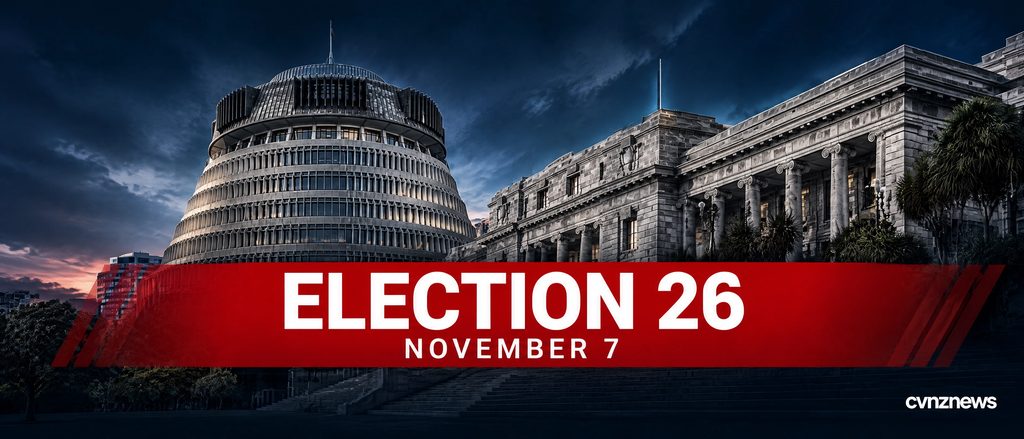
A completely unbiased ranking from worst to best of last night’s minor leaders’ debate performance, hosted by Tova O’Brien on TVNZ.
Fifth place: Winston Peters
Watching Winston Peters felt like watching a nostalgia act, with him playing all the old hits, referencing policies and stories that happened decades prior.
However, when it came to actually challenging other members of the debate stage, he usually fell like a flat fish.
He clearly went into the debate intending to target Qiulae Wong, no doubt because she represents the biggest threat to Winston’s kingmaker position.
However, his attempt to dismiss her citizen income guarantee proposal by claiming that similar schemes hadn’t worked anywhere in the world fell like a flat fish.
Now, I’ve got my criticisms of Opportunity, but one thing I can say about its candidates is that they know the details of their policies inside and out, which Winston learned first-hand when Q was quick to fire back that Ireland did, in fact, have an income guarantee for artists, effectively shutting him down.
Winston also attempted to attack the Greens over their wealth tax, only for Chlöe Swarbrick to respond by pointing out that his own policies amounted to $76 billion in uncosted promises.
And considering Winston seemed to receive more speaking time than almost anybody else on that stage, the fact that he achieved so little with it made his performance even worse.
It was not a good night for Winston.
Fourth place, and a very close fourth: David Seymour
If there’s one word I would use to describe David Seymour’s performance,
it would be neutered.
Take the exchange about mandatory drug testing for beneficiaries.
When Tova O’Brien asked which candidates supported the proposal, David was the only person to raise his hand, prompting Chlöe Swarbrick to immediately interject, “So much for libertarianism,” effectively rattling David Seymour before he’d even begun his response, which was also terrible.
Instead of explaining whether mandatory drug testing would actually work, he launched into a sermon about why it didn’t contradict his libertarian ideology.
He also attempted to deflect scrutiny of his political donations by pointing out that Opportunity had been founded by a millionaire.
Q didn’t dispute that. In fact, she took his attack and used it to illustrate how difficult it is to establish a political party without millionaire funding, effectively turning David’s attack into an argument for her own policy.
Watching David’s performance, I found myself wondering whether Simeon Brown had been running his campaign.
Because David was suffering from the same problem Christopher Luxon had during the leaders’ debate: relying on attacks against his opponents to disguise the weaknesses of his own ideas, his record and his poor polling.
And when those attacks failed, there was precious little left for David to rely on.
However, David’s worst moment was one I don’t see many people talking about.
Tova asked a pretty inoffensive question about which candidates wished they could speak more te reo Māori.
Winston Peters didn’t put his hand up. No surprise there.
But neither did David Seymour.
Now, I’m sure that refusal would have gone down beautifully with the 6% of ACT supporters watching.
But for ordinary Kiwis, many of whom would love the opportunity to learn another language, especially the indigenous language of our own country,
I suspect that small gesture would have been a terrible look for David, revealing something we already know about him: just how unpatriotic he is.
Third place: Rāwiri Waititi
Unfortunately, I don’t think the debate format did Rāwiri any favours.
Although he demonstrated an excellent understanding of his own party’s policies, and even those of ACT, particularly when dismantling David Seymour’s attacks on the Treaty, the format exposed how unfamiliar he was with some of the other parties’ proposals.
This was especially obvious during Opportunity’s segment, where Rāwiri was essentially silent throughout, which wouldn’t have been a good look for viewers at home.
However, after a slow start, Rāwiri picked up steam, particularly when challenging Seymour over the Treaty.
Also, points to Rāwiri for securing what I believe was the first and only round of applause of the night when, during the discussion about mandatory drug testing for beneficiaries, he suggested that perhaps we should start with the politicians.
He also got in a couple of good zingers at Winston Peters’ expense.
When Winston complained that Māori signage made it difficult for him to find his way around,
Rāwiri responded with a sarcastic, “Oh, you poor thing.”
Overall, Rāwiri had some excellent moments, but when the format required him to scrutinise the details of other parties’ policies, he struggled to make the same impression.
Second place: Chlöe Swarbrick
I know. I’m as surprised as anyone to be putting Chlöe here.
Perhaps recent Green performances have conditioned me to expect an exceptional showing from their candidates whenever they take the debate stage.
And although Chlöe certainly delivered another excellent performance, with consistently effective interjections, including the aforementioned “So much for libertarianism” moment, there were other highlights too.
When Winston Peters, during a discussion about improving health outcomes for Kiwis, asked why so many New Zealanders were getting cancer, Chlöe immediately shouted across the stage, “Because you’re making it easier for them to smoke.”
But this was also a very mature performance from Chlöe, who knew better than to take the beneficiary bashing bait David Seymour was putting out.
Instead, she used his proposal as an opportunity to point out that National was targeting beneficiaries to distract from its poor record and deteriorating polling.
And with all due respect to the 23-year-old Chlöe Swarbrick who first entered Parliament, I suspect she might have fallen into that trap, wasting her speaking time debating David about the merits of mandatory drug testing.
But the Chlöe we saw last night recognised that doing so would mean accepting the terms of David Seymour’s argument.
So instead of accepting the premise behind his position, she exposed the political strategy behind it.
Chlöe also seemed to understand her audience, recognising that although the Greens are proposing bold policies, bold doesn’t necessarily mean radical.
And she demonstrated that beautifully by citing Bill English, of all people, when discussing the financial and social costs of overcrowded prisons, showing just how sensible her proposals are without retreating from or sanitising them.
First place: Qiulae Wong
Yes, I’m as surprised as you are.
But the reason Q takes first place comes down to one thing.
Of all five candidates on that debate stage, Q was the only one I think would have gained additional votes from her performance.
I don’t think the debate would have substantially changed support for any of the other candidates.
But Q was given an opportunity, and she seized it.
Pun very much intended.
Because I ain’t gonna lie to you guys, I’ve had plenty of misgivings about Opportunity.
But Q absolutely knocked it out of the park.
This was easily her strongest debate performance, and how fortunate for Opportunity that it happened during the most consequential debate of the campaign.
Besides the aforementioned moments where she effectively dismantled Winston Peters’ and David Seymour’s respective attacks, I was surprised to see her even get the better of Chlöe during their exchange about the differences between Opportunity and the Greens.
Chlöe argued that the Greens would never work with a Luxon government that had rolled back climate laws, targeted the Treaty of Waitangi and opened its doors to lobbyists.
Q responded that perhaps if the Greens had been willing to work with National, those things wouldn’t have happened.
Now, as somebody who’s politically dialled in, I understand that there’s quite a lot wrong with Q’s argument here.
However, the minor leaders’ debate isn’t for people who are politically dialled in, like myself.
It’s for the people watching at home.
And I suspect those viewers would have seen Q’s response as an effective retort, one that definitely landed.

And getting the better of Chlöe Swarbrick in an exchange like that is no small achievement.
But the biggest lesson from Q’s performance, particularly for Labour and National, is the value of preparation.
Q knew her policies inside and out, was steadfast in defending them, and has taken virtually every opportunity to put herself in front of a camera.
She’s stress-tested herself through difficult interviews with Jack Tame and the guys at the Big Hairy News, gradually improving her ability to communicate her ideas under pressure.
And last night, all that preparation paid off.
Between Opportunity polling at 8% and Q’s performance on the debate stage, I think last night was the best night Opportunity has had so far this campaign.