




OPINION: Michael Swanson.
Anyone who has watched New Zealand politics over the past few weeks will have noticed something about the tone. It isn’t just policy. It’s language. Deliberately sharper, deliberately more provocative, and deliberately aimed.
I’ve spoken about this a few times in the media, including with Wallace Chapman and The Panel (RNZ), and my message each time has been the same: this is not a passing phase. It is a considered tactic, and it is going to keep going right through to November.
A pattern, not a slip
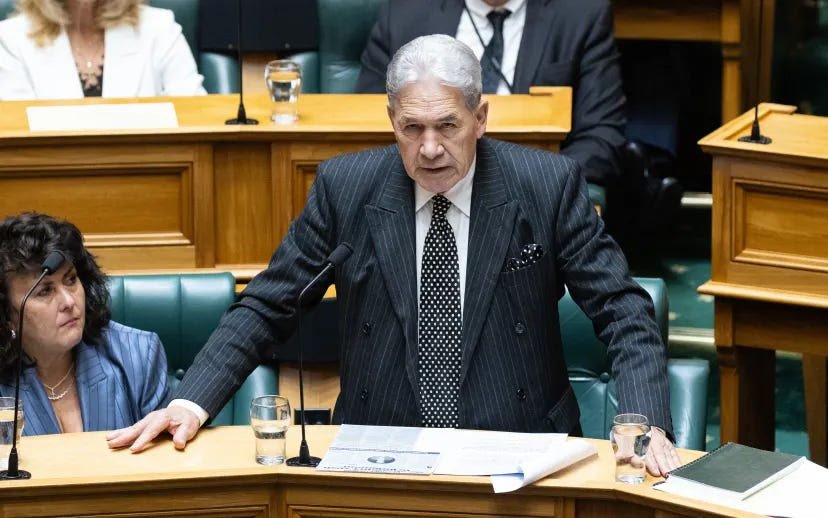
I’m sure no-one reading this missed the news about Winston Peters telling Green MP Lawrence Xu-Nan, who was born in China and raised in Auckland, to “go back to your own country” during a heated exchange in Parliament. Peters characterised his own comments as defending New Zealand’s democracy and dismissed accusations of racism as “drivel”. Prime Minister Christopher Luxon called the remarks “attention-seeking”.
It wasn’t an isolated moment. Peters has also described trade unions as “prostitutes for the Labour Party”. NZ First deputy leader Shane Jones described the government’s free trade agreement with India as a “butter chicken tsunami” in April, warning that “unfettered immigration” from the deal would drive down wages, clog roads and overwhelm the health system, and adding that he did not care how much criticism the comment drew. Jones later told a NZ First party convention that politicians should “take off your kneepads” before greeting visiting Indian Prime Minister Narendra Modi, a remark Luxon called “crass and unprofessional”.
Political communication Professor Aeron Davis has noted that this kind of crude political language is directly imported from the Trump playbook, and tends to surface whenever populist parties are on the rise. Political commentator Brigitte Morton put it plainly too: NZ First is building a record of comments that fall outside the standards we’d normally expect, citing the “butter chicken tsunami” and “kneepads” remarks specifically.
Then there’s the English Language Bill, championed by Peters as a “common sense idea” that fills what he sees as an anomaly, given Māori and New Zealand Sign Language are already official languages while English is not. Whatever the merits of the bill itself, the way it has been fought for, loudly, repeatedly, as a culture-war marker rather than a technical fix, tells you everything about the strategy behind it. As one academic analysis put it, English is spoken by more than 4.75 percent of New Zealanders, over 96 percent of the population, and already dominates television, radio, classrooms and workplaces, meaning the “threat” the bill responds to barely exists. That gap between the rhetoric and the reality is the whole point. The bill was never really about language. It was about signalling.
The Periodical is a reader-supported publication. To receive new posts and support my work, consider becoming a free or paid subscriber.
Why this, and why now
None of this is accidental, and it isn’t really about winning over new voters either. NZ First isn’t trying to expand the right-of-centre bloc. It’s consolidating its own, and doing so at National’s expense.
The RNZ-Reid Research poll from early July told the story clearly. National fell to 28.7 percent, its fourth consecutive decline and its weakest result since Luxon became leader, while New Zealand First climbed for a third straight poll to 11.5 percent, its best showing with that pollster since 2017. That movement isn’t coincidental. It’s votes shifting from one coalition partner to another, from a party seen as managerial and cautious to one seen as willing to say what others won’t.
The voters NZ First is chasing are largely disaffected National voters, people who backed Luxon in 2023 expecting a harder edge on immigration, co-governance and law and order, and who now see a Prime Minister they consider too cautious, too corporate, too easily wrongfooted. Every blunt remark from Peters or Jones is a signal to that specific voter: we’ll say what he won’t.
Why NZ First gets away with it
Here’s the part that frustrates a lot of observers, myself included, and it’s what I’ve tried to explain on air. NZ First tends to get away with this kind of language in a way other parties simply couldn’t. Peters in particular has spent decades cultivating a persona built on bluntness and provocation. It is, at this point, part of the brand. Voters who like Peters expect him to say outrageous things at this point. It’s baked into how he’s understood.
Other parties don’t have that same licence. They’ve spent years positioning themselves around competence, discipline or moral responsibility, and that positioning becomes a cage. If a National minister used the same language as Jones, or a Labour MP used the same language as Peters, the backlash would be immediate and probably fatal to their career, or at least their ministerial future or aspirations. NZ First has effectively built itself an exemption. The outrage cycle plays out, a few days of headlines, some pointed questions in the House, and then it moves on, because everyone has come to expect it.

The test for Luxon
This is where it becomes a genuine problem for the Prime Minister, not just an awkward coalition dynamic. Luxon’s response to date has largely been a string of adjectives: “unhelpful,” “crass,” “attention-seeking.” Words like that read as disapproval without consequence. They cost NZ First nothing and they don’t reassure the voters drifting away from National either.
If Luxon wants to stop the bleeding he needs something firmer than a wince and a soundbite. That doesn’t necessarily mean threatening the coalition, which nobody expects nine months from an election. But it does mean drawing an actual line, being specific about what crosses it, and being consistent when it does. Right now the pattern is: comment happens, mild rebuke follows, cycle repeats. Voters, including plenty inside National’s own base, are watching that pattern and drawing conclusions about who is actually setting the tone of this government.
Leadership in this context isn’t about matching Peters and Jones for combativeness. It’s about showing that there are standards that apply across the coalition, not just to the parties without Peters’ decades of built-up credit. Until Luxon does that, the language coming out of NZ First will keep doing exactly what it’s designed to do: crowd out National’s own voice, define the coalition’s tone from the outside, and pull disillusioned National voters toward the party that sounds like it means it.
As I’ve said on The Panel twice in as many weeks, this isn’t just a phase, and it won’t stop in the lead up to the election in November.