


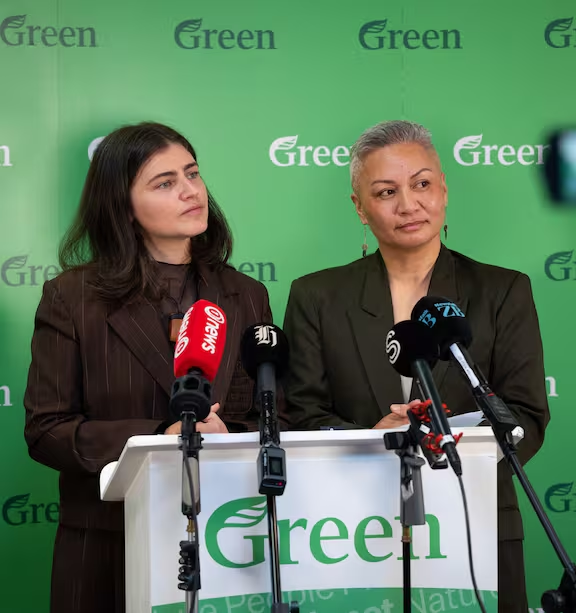
Factors favouring the Greens include a clear, bold vision, popular leaders, a weak Labour Party, and global demand for change on the left. But can the party’s momentum continue with a month to go?
OPINION: Elliot Crossan
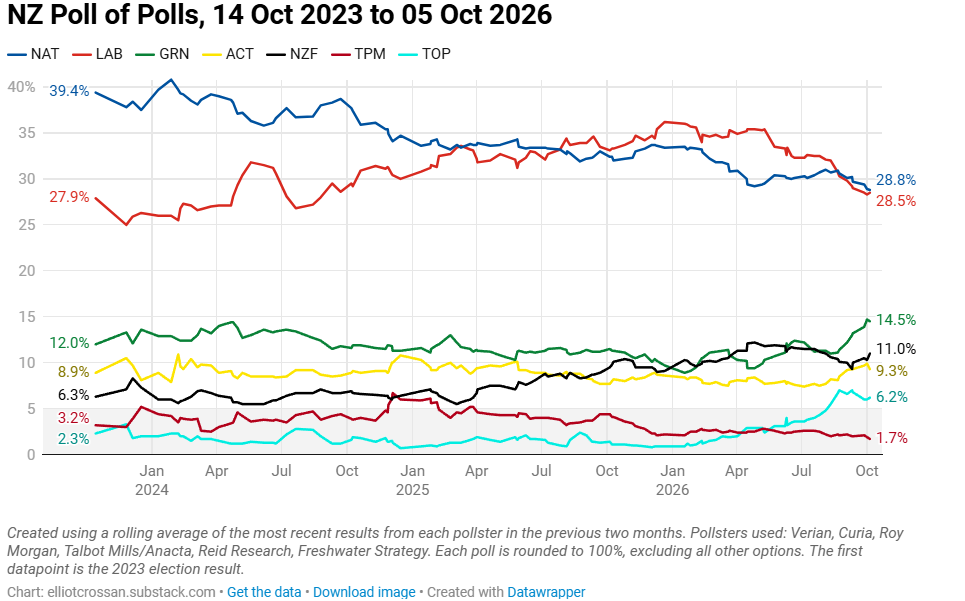
The Green Party of Aotearoa New Zealand is currently surging in the polls. The party is up to an all-time high of 16% in two consecutive 1 News-Verian polls, and is currently projected to win a record number of seats according to 5 of 6 pollsters. The Greens are gathering steam with a month to go in the 2026 election campaign, and will be hoping their momentum continues to build.
Here are four reasons why the Greens are currently taking their popularity to new heights:
1. A Clear, Bold Vision
The mood of the country is sour. Unemployment and inflation are high; the government’s austerity programme has stalled the economy and starved our public services of funding. Both National and Labour are running ‘small target’ campaigns, promising little to voters struggling in the cost-of-living crisis.
Contrast the lukewarm offerings of the major parties with the Greens. Nearly every major policy announcement from the party has been laser-focused on affordability. From capping public transport fares to bringing down power bills and reducing the cost of food, they’re promising concrete solutions to the sky-high cost of living.Subscribe
One of the Greens’ flagship policies is to establish KiwiMart, a publicly owned supermarket to compete with the supermarket duopoly. The announcement of this bold plan to bring down exorbitant food prices at the end of August coincided with the party’s recent polling surge.
Underpinning the Greens’ message on affordability is a coherent narrative about why the economy is not working for the vast majority of Kiwis: because the economic system is rigged and inequality is out of control. To raise living standards for working class people, the super-rich must pay their fair share.
The party’s tax reform package also focuses on affordability, with the Greens promising to create a $10,000 tax free threshold. This will be paid for by a series of tax increases on the super-rich. 96% of New Zealanders will receive a tax cut, while overall government revenue will increase by $5.7bn by 2030 to pay for the rest of the Greens’ agenda. To the surprise of many commentators, the wealth tax at the centre of the package is wildly popular.
An Ipsos poll conducted for the Spinoff found that 64% support the party’s proposed wealth tax, with just 26% opposed. This contrasts with Labour’s Capital Gains Tax (CGT), which is supported by 45%, with 40% opposed. A wealth tax will raise significant revenue and will make an impact on inequality; it’s easy to understand and easy to argue for. Labour’s CGT does none of these things — instead it is technocratic, uninspiring and will have a negligible effect if implemented.
The cost-of-living is the biggest issue for voters in this election; it’s no wonder that the party with the momentum right now is the party most focused on making life more affordable. The Greens’ clear, bold and coherent vision is catching the eye of working people who are sick and tired of the rich getting richer while everyone else struggles to make ends meet.
2. Labour’s Weakness
Since the Greens first entered Parliament in 1999, their fortunes have been inherently tied to the fortunes of the Labour Party. When Labour is popular, support for the Greens shrinks; when Labour is struggling, the Greens tend to regain momentum.
The Greens have contested 9 elections under MMP to date. The party won between 5.2% and 7.9% in the six elections when Labour was led by either Helen Clark or Jacinda Ardern. In the three elections where Labour had a less popular leader, however — Goff in 2011, Cunliffe in 2014, and Chris Hipkins in 2023 — the Greens won between 10.7% and 11.6%.
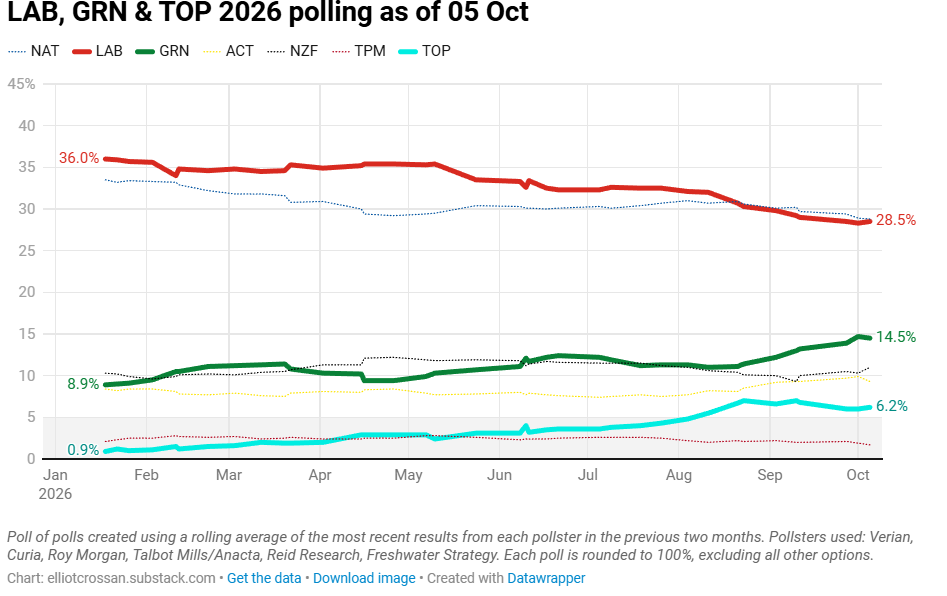
Hipkins may have been roundly rejected by the electorate in 2023, but he managed to slowly turn his party’s fortunes around as Leader of the Opposition. By August last year, Labour was ahead of National in the polls. At the beginning of 2026, Labour was polling at 36%, with the Greens down on 8.9%.
Yet Hipkins has squandered his advantage. Labour spent most of the term refusing to commit to major policy decisions, and once the party entered campaign mode it became clear why: Hipkins has nothing to offer to the electorate. His entire plan was to coast back into power thanks solely to the unpopularity of Luxon’s government.
The ‘small target’ strategy appears to be backfiring spectacularly. Since May, Labour’s polling has collapsed, with the primary beneficiaries being the Greens and the Opportunity Party. Compared to the start of the year, Labour is down 7.7% from 36% to 28.3%; Opportunity is set to enter Parliament for the first time, up from 0.9% to 6.2% (+5.3%); and the Greens are up 5.8%, from 8.9% to 14.7%.
Far from capturing the imagination of the mythical ‘middle New Zealand,’ Labour is losing votes to two parties promising structural change to the economic system that is clearly broken. With its slick, corporate-friendly approach, Opportunity appears to be taking more centrist-inclined voters away from both of the major parties, while the Greens outflank Labour from the left.
Hipkins has been caught in a pincer movement, and the Greens are going from strength to strength as a result. The party’s stated goal is not merely to put more pressure on Labour, but to replace them as the main party of the NZ left; and with Labour so adamantly committed to status quo politics, the moment is ripe for the Greens to steal a chunk of their base with an offer of genuinely transformational change.
3. Popular Leadership
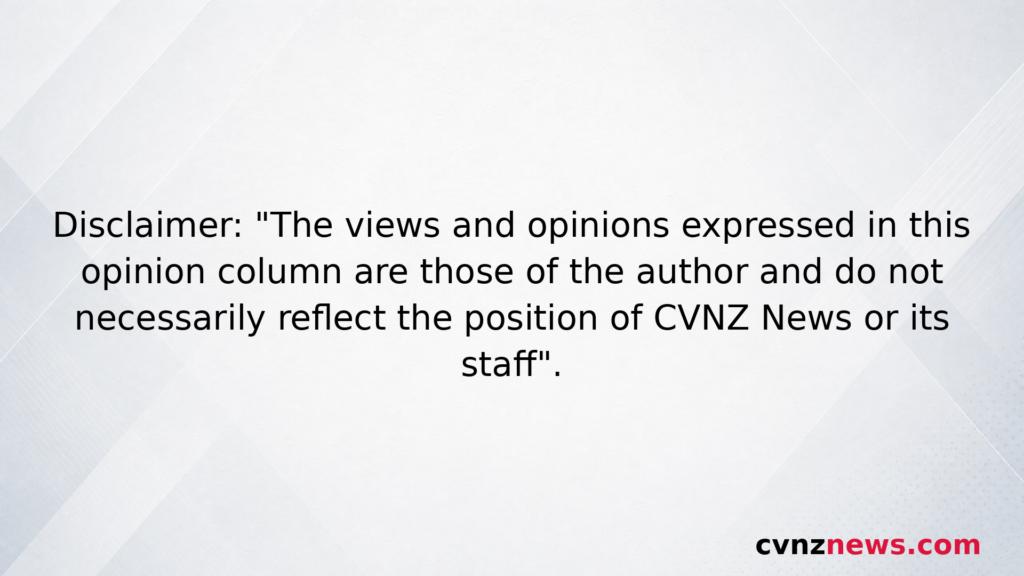
Chlöe Swarbrick is the most popular co-leader in the history of the Green Party. According to the Progress Report’s database, the previous best result for a Green co-leader in the Preferred Prime Minister ratings was 4.5% for Russel Norman in 2014. Since she was elected co-leader in 2024, Swarbrick has regularly polled between 4% and 10%, with her best result being 10.9%.
Thanks to the leadership of Marama Davidson and her colleagues in the Greens’ growing Māori caucus, the party is on course for a major breakthrough with Māori voters. Labour has won the party vote in the Māori seats in every election since 1999 — but a Mata-Horizon poll of voters on the Māori roll in September showed the Greens on course to triple their party vote, leading Labour by 1 point.
The clarity of the Greens’ message in the 2026 election, their message discipline and their cut-through can all be attributed in no small part to the performances of Davidson and Swarbrick as communicators. It can also be attributed to the fact that the leadership team has a shared political perspective. In the 2020 and 2023 elections, Davidson was paired as co-leader with the more centrist, corporate-friendly James Shaw. In 2026 however, the Green Party now has two co-leaders who share the belief that the economic system is fundamentally broken, and that only a clear break with neoliberal economics and status quo politics can succeed in the current climate.1
Popular leadership is necessary, and united leadership is vital. There’s still a month to go, but the direction Davidson and Swarbrick are taking the Green Party in appears to be paying off.Subscribe
4. Global Winds of Change
Around the western world, left-wing voters are increasingly rejecting the broken political and economic system. It’s been 11 years since Bernie Sanders’ first campaign to become US president began to gather momentum; now his protegees, the most prominent being Alexandria Ocasio-Cortez and New York mayor Zohran Mamdani, are beginning to gain the upper hand in the battle for the soul of the Democratic Party.
It’s also been 11 years since Jeremy Corbyn’s shock election as leader of the UK Labour Party. Following in Corbyn’s footsteps, self-proclaimed ‘eco-populist’ Zack Polanski became leader of the Green Party of England and Wales last year. The Greens began to surge in the polls at the expense of an already unpopular Labour government, so much so that Prime Minister Keir Starmer was forced to resign as Labour desperately shifted to the left.
The NZ Greens are taking lessons from the likes of Mamdani and Polanski and running with them. The KiwiMart announcement was inspired directly by Mamdani. It’s a two-way street — Polanski cites Swarbrick as one of his political inspirations. Swarbrick toured Europe last year to meet with left-wing leaders and progressive economists. The Greens’ current strategy and its apparent success is no fluke; it is part of a global trend, and Aotearoa is late to the party.
One common feature of insurgent left-wing populist campaigns is that they often lose ground outside of election cycles, only — if they play their cards right — to regain momentum once the campaign is on. The polling data frequently shows a late, often unexpected surge in support for left-wing candidates. This trend can be observed across various recent elections in the US, UK, France, Germany and elsewhere.
There are two explanations for this trend.
The first is summed up by one of Mamdani’s catchphrases — that only organised people can defeat organised money. With both the 2023 and 2026 NZ elections shattering previous records for big-money donations to the right-wing parties, it is more important than ever that the left answers by mobilising grassroots campaigns to spread an alternative message.
Left-wing activists are inspired when their leaders are unapologetically campaigning for transformational change. Visionary leadership captures the imagination of volunteer armies willing to hit the streets or make hundreds of phone calls to strangers in an attempt to win over hearts and minds. Centrists who are wedded to the status quo are unable to inspire the same feelings of hope.
The super-rich, in NZ and around the world, are only getting more aggressive in their attempts to buy elections and take over news outlets to promote their interests. During the political off-season, when most voters aren’t paying attention and grassroots armies of volunteers are demobilised, the media and well-funded right-wing lobby groups can chip away at the reputations of left-wing parties and their leaders through a constant drip-feed of negative stories and headlines.
This phenomenon partially explains the general narrative of scandal and incompetence which damaged the Greens’ image throughout 2024 and 20252. But this brings us to the second explanation: during election season, people start paying attention.
In the lead-up to an election, voters start to look at what the parties are actually offering. Policy debates start to matter, and electoral laws kick in which make the terms of debate fairer.
When everyone is paying attention, as long as the message is clear and the policy offer is bold, a well-executed insurgent campaign can start to gain incredible traction. To the media, it looks like a bolt from the blue; a stunning upset. But to tireless activists spending every weekend out campaigning, it’s obvious what happened. The time was right, and people started listening.
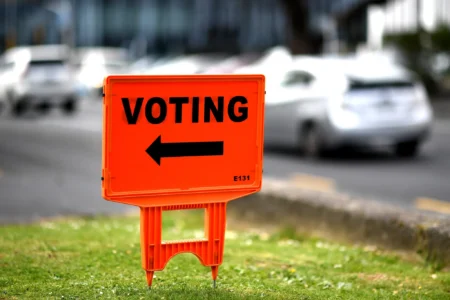
If we want to see a genuinely transformational left-wing government elected on November 7th this year, our only hope is that the Green Party’s momentum continues to build, and that they receive a high enough percentage of the party vote to exercise pressure that even Chris Hipkins cannot ignore. Nothing is guaranteed either way — but the potential is there for the Greens to make history. Let’s hope enough people are listening.
About the Author: Elliot Crossan describes himself as a writer and activist based in Tāmaki Makaurau Auckland, who writes about NZ and world politics from a socialist perspective.