

Colin Ambler/cvnznews.com

Labour leader distances himself from gang-pad controversy as election crime battle explodes
Labour leader Chris Hipkins has publicly rebuked his potential coalition partners and ruled out giving the Greens or Te Pāti Māori control of key law-and-order portfolios after their representatives attended a hui with Mongrel Mob figures.
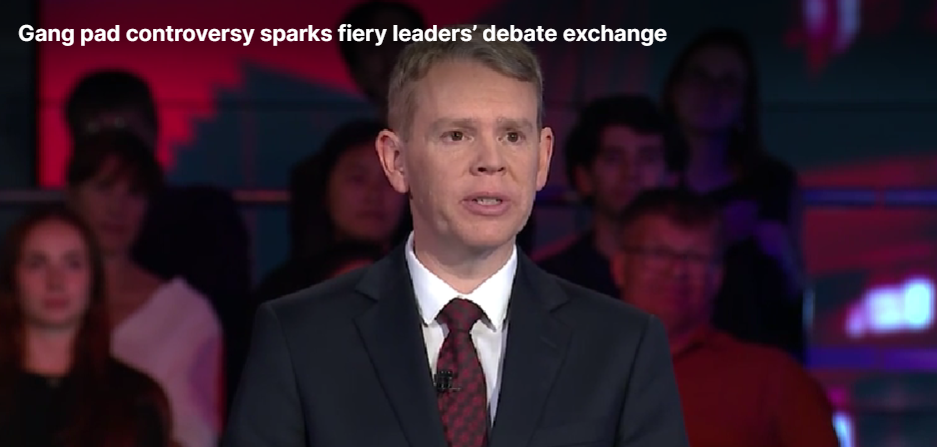
The dramatic intervention came during the NZ Herald leaders’ debate, where Hipkins was pressed over photographs showing Green and Te Pāti Māori politicians at a Mongrel Mob-affiliated venue alongside lifetime gang figure Harry Tam.
His response was blunt.
“I don’t condone it. I think it was bad judgment,” Hipkins said.
More significantly, he went a step further, declaring that neither the Greens nor Te Pāti Māori would receive the Police or Corrections portfolios in a government led by Labour.
The comments amount to one of the clearest public signals yet that Labour is concerned about voter backlash over crime and gang issues as the election campaign enters its final stages.
National leader Christopher Luxon wasted no time turning the issue into an attack on Labour’s governing prospects.
“Law and order starts from the top,” he said.
Luxon accused Hipkins of surrounding himself with coalition partners whose views on crime were out of step with mainstream New Zealanders.
Earlier, he sharpened the attack even further, quipping that Hipkins had gained “a new coalition partner” in the Mongrel Mob.
The controversy erupted after Te Pāti Māori MP Oriini Kaipara and Green candidates attended a health and wellbeing hui held at a Mob-affiliated venue.
Critics say the optics are disastrous at a time when voters remain deeply concerned about gangs, drugs and violent offending.
Supporters of the meeting paint a different picture.
Green co-leader Marama Davidson defended the visit, arguing that politicians should engage with all communities, including marginalised groups.

“We’re not apologising,” Davidson said, insisting that democracy requires politicians to listen to everyone.
But with crime emerging as one of the defining issues of the campaign, Hipkins appears determined to put distance between Labour and the controversy.
His declaration that Police and Corrections would remain out of the hands of the Greens and Te Pāti Māori will likely reassure some centrist voters.
At the same time, it raises an awkward question for a potential Labour-led coalition:
If Hipkins doesn’t trust his partners with law and order, how much confidence does he really have in the policies they’re promoting?