


Opinion Dr Muriel Newman
On one side is a coalition that wants to encourage people to get ahead through lower taxes, less regulation, stronger economic growth, and more freedom. On the other side are parties that want to penalise success.
Labour, which proved itself to be not only incompetent at managing our country but downright destructive, wants to tax us more. Not content with having the power to control what we earn through income tax, they now want to get their hands on our assets as well. And while they claim their 28 percent Capital Gains Tax (CGT) will only affect investment property – including baches – history suggests that once such a tax is in place a government’s insatiable need for more money will invariably see the rules being “tweaked” and with the stroke of a pen family homes, farms, shares, or any other assets could be captured in the tax net as well.
That’s why New Zealanders have always had a deep-seated distrust of a CGT, rejecting repeated attempts to introduce one – with former Prime Minister David Lange once describing it as the sort of tax you introduce if you want to lose not just one election but the next three.
Then there’s the Greens. While they originated within the environmental movement, they have now morphed into a communist party in all but name. They feed on the politics of “envy and greed”, with their major ‘Tax the Rich’ election platform attempting to generate a victim mentality amongst voters to provoke hatred towards anyone doing well. According to their mindset, middle class families are rich oppressor-types who deserve penalising through punitive taxes: a top income tax rate of 45 percent, a 2.5 percent wealth tax, a 33 percent inheritance tax, an extension of the bright-line test from 2 to 10 years, removal of tax deductibility on investment property, a rise in company tax to 33 percent, and a 5 percent withholding tax on offshore profits.
The Māori Party also favours an increase in the top tax rate to 48 percent, a 2.5 percent wealth tax, an increase in company tax to 33 percent, an additional 5 percent foreign company tax, a land banking tax of 33 percent, a ‘batch and vacant home’ tax of 2 percent, and a 5 percent Stamp Duty.
At the most extreme end is The Opportunity Party. TOP doesn’t just want to penalise anyone trying to get ahead through tax; it wants to control their lives. Their objective is to scrap the lowest income tax rates, introduce a new land tax, and pay people a universal benefit so everyone becomes dependent on the State.
It’s important to remember that at this election the family home isn’t just under threat from tax: both the Māori Party and the Greens have indicated they want private land opened up for a new round of Treaty settlements.
While Labour is currently saying ‘no’ to the new tax demands of coalition partners, it cannot be forgotten that this is the same party that once embraced the Orwellian ‘single source of truth’ mantra — a reminder that their guarantees ultimately meant nothing.
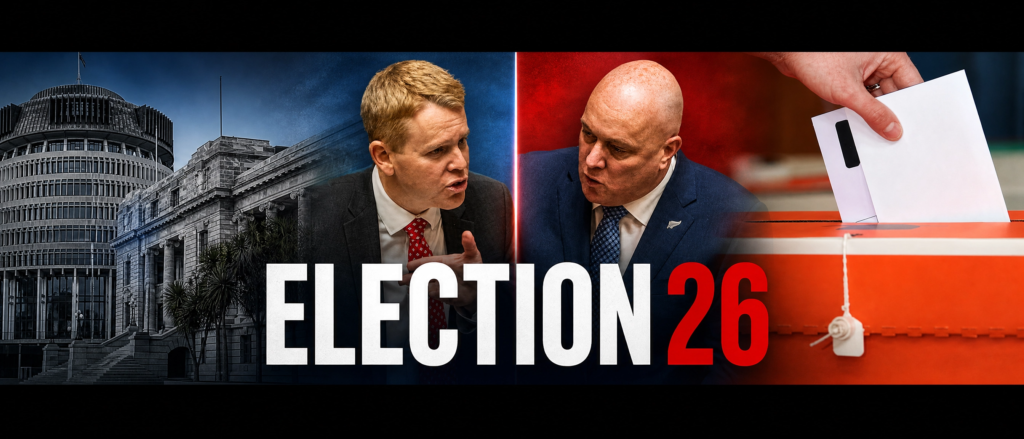
If it’s the difference between Chris Hipkins becoming Prime Minister or remaining Leader of the Opposition, we all know how easy it would be for pre‑election promises to be forgotten.
What also seems to be forgotten this election is the mess Labour made of running the country when they were last in government.
Virtually the whole time Labour held the Treasury benches, they were not subjected to proper scrutiny by the mainstream media. Jacinda Ardern was their protégé — the leader they helped elevate through relentlessly positive coverage. As a result, their treatment of Labour was kind, in contrast to the approach taken with the current government.
In reality, the Coalition has been subjected to almost three years of unrelenting attack — a scandal in itself since the media are meant to be objective and balanced.
Whether this relates to the fact that around half of the country’s journalists belong to an activist union affiliated to Labour is difficult to tell, but media bias in favour of the left is unmistakable.
Faced with media negativity and fading memory of Labour’s incompetence, it’s easy to see why voters might be persuaded to pin their hopes on a “new” government, especially when economic recovery has been slow.
As if media influence is not bad enough, a new rort has emerged.
The Māori Party intends gaming the 2026 election by using the Māori seats to gerrymander a change in government.
We’ve seen attempts before. In 2014, Hone Harawira tried to use his Te Tai Tokerau seat to piggyback Kim Dotcom’s Internet Party into Parliament — a $3 million attempt to sidestep the MMP threshold. Voters rejected it.
The Māori Party’s plan involves convincing supporters to split their vote: electorate votes to Māori Party candidates, party votes to Labour or the Greens. Their aim is to create a massive overhang of six or seven seats, likely swinging the election.
An overhang occurs when a party wins more electorate seats than its party vote entitles it to. Parliament becomes larger and more disproportionate.
The overhang mechanism was never intended to be used to deliberately undermine democracy.
Co‑leader Rawiri Waititi is already claiming victory: “If Te Pāti Māori wins the seven Māori seats, the Greens hold 12–13%, and Labour holds 34%, we’ve got a change in government.”

Public law expert Liam Hehir warns the plan could backfire and lead to abolition of the Māori seats.
The distortionary impact of the Māori seats is now significant: Māori make up 27 percent of MPs, far exceeding their 17 percent share of the population. Even without the reserved seats, Māori would still be overrepresented.
But the deeper issue is that the seats are now being used to radicalise government structures — embedding tribal authority into public institutions.
Historic Treaty claims have been reopened, tribal corporations handed public assets, and radical frameworks like He Puapua advanced.
The Māori seats have become a gateway for tribal power at the expense of equal citizenship.
If New Zealand cares about democracy, the Māori seats cannot remain.
The Māori Party’s attempt to rig the election should be the final nail in their coffin. The Coalition must now promise a referendum on the Māori seats if re‑elected.
Kiwis believe in giving everyone a fair go — but we have little tolerance for anyone playing dirty.
Whether voters on the Māori roll reject the attempt remains to be seen, but the Coalition must give New Zealanders the chance to decide whether the Māori seats stay or go.
This article was first published at NZCPR.