



Mike Bain | cvnznews.com
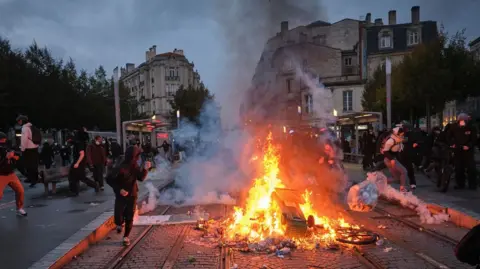
When French teenagers are setting fire to schools to protest a lack of investment in education, something has gone badly wrong.
And when young people across Paris, Madrid, Brussels, and other European cities are pouring onto the streets demanding action on housing, jobs, and public services, the easy assumption is that they are protesting governments, capitalism, immigration, globalisation, or whatever happens to be the political villain of the day.
Historian Niall Ferguson argues something much more confronting.
The young Europeans filling the streets may be protesting the wrong people.
In a provocative essay titled Why Europe Is Burning, Ferguson suggests that behind the riots, demonstrations, and growing political instability lies a problem few politicians are willing to name: a system increasingly designed to benefit the old at the expense of the young.
It is a thesis guaranteed to provoke debate. Yet it raises questions New Zealanders would be wise to consider before dismissing Europe’s troubles as someone else’s problem.
The Generational Squeeze
For decades, European nations built generous welfare systems on assumptions that made sense in the post-war years.
Families were larger.
Birth rates were higher.
Life expectancy was shorter.
And there were plenty of workers supporting a relatively small retired population.
That equation has changed dramatically.
Across much of Europe, birth rates have collapsed while life expectancy has increased. The result is that fewer workers are supporting more retirees than ever before.
The political consequences are profound.
Older citizens vote in large numbers. Politicians know this. Policies increasingly cater to retirees because they represent a powerful and reliable voting bloc.
Meanwhile younger generations face exploding housing costs, stagnant wage growth, rising taxes, larger government debt burdens, and shrinking opportunities to accumulate wealth.
The uncomfortable reality is that many young Europeans are discovering they are paying for systems they may never fully benefit from themselves.
They are being asked to fund pensions, health systems, and social commitments created for a demographic reality that no longer exists.
As Ferguson bluntly puts it, today’s young people know they are getting a bad deal. They simply haven’t correctly identified who is giving it to them.
A Problem Beyond Europe
Although Ferguson’s focus is Europe, the warning extends far beyond Paris.
Across much of the Western world, including New Zealand, similar demographic pressures are emerging.
Like Europe, New Zealand has an ageing population.
Like Europe, birth rates have fallen.
Like Europe, governments are wrestling with rising healthcare costs and retirement spending.
And like Europe, younger people face increasingly difficult pathways into home ownership.
Many parents instinctively recognise it.
The economic milestones once considered normal are becoming harder for the next generation to reach.
A first home. Marriage. Raising children. Building savings.
For many young adults these goals are delayed or seem increasingly unattainable.
That frustration inevitably seeks an outlet.
The Search for Someone to Blame
One of Ferguson’s most powerful observations is that societies often misdiagnose their deepest problems.
When people become frustrated, they search for villains.

The political left points toward billionaires.
The political right points toward immigrants.
Activists point toward corporations.
Populists point toward global institutions.
Yet underlying demographic realities remain largely untouched.
Politicians prefer easier targets.
After all, blaming the rich, foreigners, multinational corporations, or distant bureaucracies wins headlines and votes.
Telling voters that decades of demographic decline have created unsustainable public spending commitments is far less popular.
Unfortunately, reality eventually demands an answer.
Ignoring arithmetic does not make it disappear.
The Christian Question
For Christians, Ferguson’s argument raises important questions that go beyond economics.
Scripture consistently commands honour for older generations.
The Bible condemns societies that abandon their elderly.
Caring for widows, grandparents, and vulnerable people is not optional for believers.
But the Bible also values justice between generations.
A healthy society does not consume its future in order to preserve its present comfort.
It plants trees whose shade it may never sit under.
It leaves an inheritance for its children and grandchildren rather than debts they must carry.
When one generation continually transfers costs forward while protecting its own benefits, the question becomes not simply economic but moral.
Are we stewarding well what has been entrusted to us?
Or are we quietly spending tomorrow’s resources today?
More Than Money
The deeper issue may not ultimately be fiscal at all.
Western societies spent much of the last century pursuing prosperity, security, comfort, and longevity as supreme goals.
Many succeeded remarkably well.
People today live longer than previous generations could have imagined.
Healthcare is better.
Material wealth is greater.
Retirement can last decades.
Yet many younger people seem less hopeful than their grandparents were.
Despite unprecedented technological advancement, a growing number feel locked out of opportunity and disconnected from purpose.
That suggests the crisis is not merely economic.
It is also spiritual.
A civilisation that loses confidence in its future eventually struggles to persuade young people that sacrifice is worthwhile.
Without a vision larger than personal comfort, politics becomes an endless battle over who gets the largest slice of a shrinking pie.
A Lesson for New Zealand
New Zealand is not France.
No one is setting schools on fire in Te Awamutu.
Our political culture remains far less combustible than much of Europe.
But it would be foolish to assume we are immune to the same underlying pressures.
Housing affordability, ageing demographics, public debt, declining birth rates, and growing generational divides are all present here too.
The challenge is to identify the problems before frustration erupts into anger.
Ferguson’s essay may overstate some of its conclusions. Not every social problem can be blamed on demographics, and not every pensioner is living comfortably while young people struggle.
Yet his central question deserves attention.
What happens when a society becomes increasingly organised around the interests of those nearing the end of life rather than those building it?
That question should concern policymakers.
It should concern families.
And it should concern churches.
Because a nation that steadily mortgages the future of its young eventually discovers that demographic decline is not merely an economic issue.
It is a crisis of hope.
And once hope begins to burn, putting out the fire becomes far harder than preventing it in the first place.
Editorial note: This article draws on and engages with arguments presented by historian Niall Ferguson in his essay Why Europe Is Burning. While it reflects Ferguson’s central thesis regarding generational imbalance, the analysis and conclusions are adapted for a New Zealand Christian readership and do not necessarily endorse every aspect of Ferguson’s argument.