

Mike Bain/cvnznews.com
Greenpeace activists boarded a government-owned research vessel in Wellington Harbour on Friday in a protest against deep-sea mining, prompting a police response and renewed debate over the future of seabed mineral exploration.
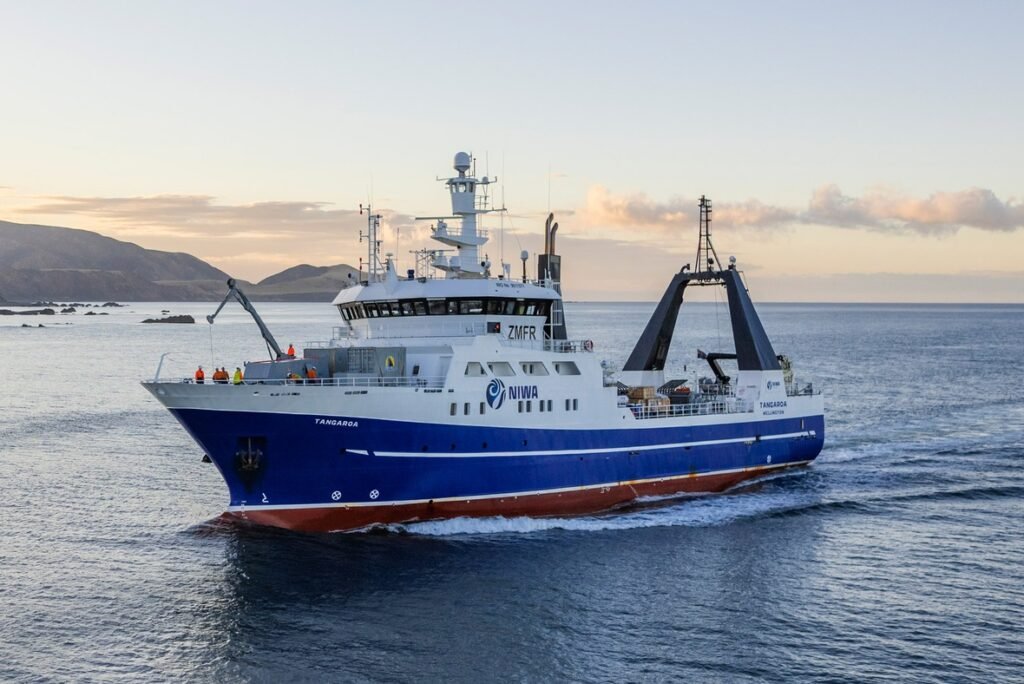
The protest targeted the RV Tangaroa, operated by Earth Sciences New Zealand, after the vessel returned from a scientific expedition in the Pacific’s Clarion-Clipperton Zone, an area rich in valuable seabed minerals.
Greenpeace said activists climbed aboard the vessel to oppose research work linked to mineral exploration. One protester dressed as US President Donald Trump and flew an American flag from the ship, while another displayed a banner reading “Don’t Mine the Moana”.
Police attended the scene and removed five protesters from the vessel. Charges were being considered.
Greenpeace spokesperson Juressa Lee said the organisation was concerned that a New Zealand state-owned research vessel had been used to support work for US-based seabed mining company Glomar Minerals.
She claimed deep-sea mining posed significant environmental risks and argued New Zealand should stand with Pacific nations opposed to the emerging industry.
Resources Minister Shane Jones criticised the protest, describing it as a publicity stunt and defending the work carried out by the vessel and its scientific staff.
“The Tangaroa is run by an independent board and a government-owned agency driven to generate revenue as part of its scientific mandate,” Jones said.
Earth Sciences New Zealand said it provides independent scientific research to national and international organisations, including expertise in marine ecology, geology and deep-ocean environments.
The agency said its research helps build scientific understanding of deep-sea ecosystems and provides evidence that can inform regulatory decisions about future activities.
Glomar Minerals has previously confirmed the Tangaroa was involved in a 65-day survey of polymetallic nodules in the Clarion-Clipperton Zone. The deposits contain minerals such as nickel, cobalt, copper and rare earth elements, which are increasingly sought after for advanced technology and manufacturing.
The incident highlights growing tensions between environmental campaigners and those advocating for the development of critical mineral resources in the Pacific.