

OPINION; Michael Swanson.

When a party polling near the threshold announces its post-election bottom lines, the usual cynical reading is that it is either grandstanding or getting ahead of itself. The Opportunity Party’s announcement on Tuesday is neither. It is a modest, sensible move, and voters are better off for it.
What was announced
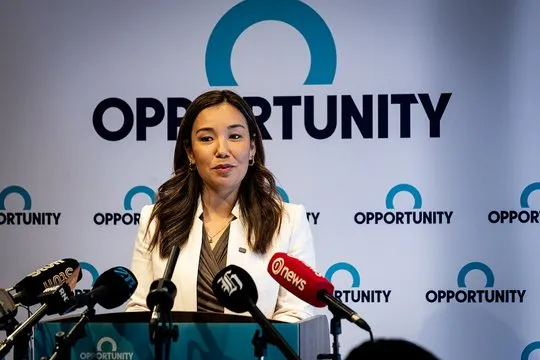
Leader Qiulae Wong set out five bottom lines that she says are the minimum commitments Opportunity would require from the next government in return for its support. They are:
- Giving the Commerce Commission more teeth and greater independence to tackle excessive market power in supermarkets, banks and other uncompetitive sectors.
- Regulating lobbying and capping political donations.
- Developing a 10-year plan for the health system, with the workforce, funding and infrastructure commitments that entails.
- Ending bottom trawling (starting in the Hauraki Gulf).
- Recommitting to Paris Agreement obligations and protecting the independence of the Climate Change Commission.
Wong said she is open to either a full coalition or a confidence-and-supply arrangement. Separately, she maintained that Opportunity would not support a government in which Winston Peters is foreign minister. She framed that as a standing position rather than one of the five positive policies.
What was missing
The NZ Herald was quick to point out that the two policies most voters associate with the party, a land tax and a universal basic income, are absent from the list. Critics will call that a retreat. I think it is the smartest part of the package.
Wong’s explanation is consistent with what she has said for weeks. In an August interview, she said the party did not expect tax reform to happen overnight, and pointed to innovation, competition and energy policy as areas that affect the cost of living without needing the tax system to change. On Tuesday she added that any significant tax change has to be durable. She also noted that other parties have characterised Opportunity as a land tax party, when its supporters know it stands for much more. That is a fair rebuttal to a caricature the party has carried since 2017.
Why this was a good idea
The strongest argument is about sequencing. Opportunity has never held a seat in Parliament. It sits on the cusp of the 5 percent threshold, and the latest 1News poll had it down from 8 percent at the previous survey. A party in that position that drew hard lines in the sand over its most ambitious and contested policies would be doing the political equivalent of buying a house before it has a job. Demanding a land tax as the price of entry would have all but guaranteed a stand-off with whichever major party ended up leading talks, and would have made Opportunity an easy target for anyone wanting to paint it as unreasonable.
Instead, Wong chose bottom lines that she says are “achievable and realistic” within a single term and that both Labour and National could plausibly accept. Supermarket competition, health planning and cleaner politics are hardly exotic. Polling and public frustration suggest the first is popular across the spectrum, and the Commerce Commission’s role in grocery competition has already been a live issue for governments of both stripes. Choosing common ground is not weakness. It is what a party does when it wants to be useful rather than merely pure.
The second argument is transparency. The point of announcing bottom lines before an election is that voters get to see what they are buying. A vote for Opportunity on 7 November is now a vote for a defined minimum: a tougher Commerce Commission, a lobbying and donations overhaul, a decade-long health plan, an end to bottom trawling, and a protected Climate Change Commission. If the party holds the balance of power, it can be measured against that list. That is a far better arrangement for accountability than the vague “we’ll see what’s on the table” approach that many parties adopt until the night of the result.
It is worth noting that the list is a floor, not a ceiling. Wong has been explicit that the party’s wider agenda, including tax, could be advanced later once it has a foothold. She has also declined to name ministerial portfolios, saying every party has its own approach to campaigning. Compare that with the Greens, whose co-leader Chloe Swarbrick has already put finance, energy, state-owned enterprises and climate change on her wish list. Neither approach is wrong, but Wong’s restraint suits a party that has yet to win a single electorate or clear the threshold.
The fair criticisms
None of this makes the announcement flawless. The obvious awkwardness is the donations cap. Wong was pressed by Jack Tame on why the party campaigns for a $30,000 cap while having received more than $400,000 in donations this year. Her answer was, in essence, that you must work within the existing rules to change them. That is defensible, and it is the same logic every reform party faces, but it will keep coming up until the party either adopts the cap voluntarily or wins the right to legislate it.
There is also the flexibility question. Stuff noted that Wong has given herself some room with the bottom lines, and that the Winston Peters position came before this announcement and was not in the handout. Voters who like firm commitments may find that untidy. But a bottom line with no room to move is not a negotiating position, it is an ultimatum, and ultimatums from a party with no seats tend not to end well.
Then there is the risk that loyal supporters feel sidelined. If a land tax was the reason someone joined the party, seeing it missing from the list will sting. Wong will need to keep making the case that tax reform is a long game, not an abandoned one.
The verdict
Taken as a whole, this was a fair and well-judged move. It gives voters a clear, modest and knowable set of commitments. It avoids the trap of over-promising from outside Parliament. And it signals that Opportunity wants to be a constructive participant in whichever government forms, rather than a spoiler.
The party is asking voters for a chance, and it has told them plainly what the minimum return on that chance looks like. Whether five broad policies is enough to carry it past 5 percent is another matter. But as a way of saying “this is the least you will get from us this time around”, it is honest, achievable and, for a first-time contender, exactly the right tone.