


OPINION: Michael Swanson/Substack

The Periodical looks at the institutions the form the political structures in our society, with a particular focus on New Zealand Politics, and political structures, but with occasional thoughts about these institutions globally.
Ask which electorates will decide the 2026 election and most people picture government and
opposition trading blows in a handful of marginals. Under MMP that is the wrong picture. Only 71 of the 120 seats come from electorates, and the party vote decides how the whole House is shared. A National win in one seat and a Labour win in the next mostly change who sits on each side, not how big each side is.
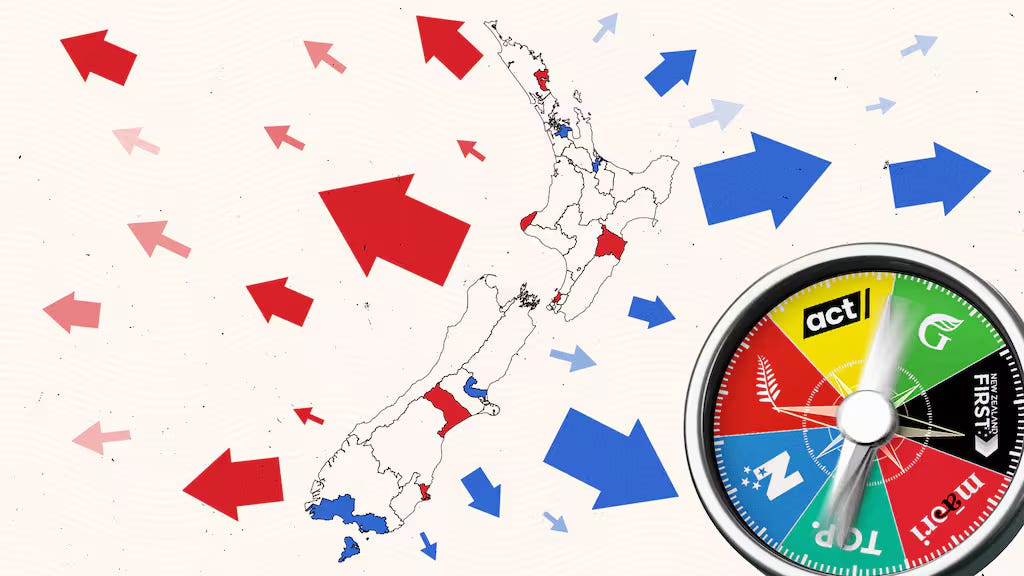
So what can electorate races do that the party vote can’t? My reading is that they expose the fights inside each bloc, and occasionally add seats to the House itself. Most of the contests I’m watching are between parties that would happily govern together. Roy Morgan’s August poll had the National-led bloc on 49% and Labour, the Greens and Te Pāti Māori on 41%, but whichever side is ahead, the leakage inside the blocs is where electorates bite. Call it the fragmentation election.
The left’s civil war
Start in Mt Albert. It has only ever elected Labour MPs, yet Helen White held it in 2023 by 18 votes after a recount. She blamed a divided left: the Greens’ Ricardo Menéndez March took 6,012 votes, and White argued Labour and the Greens had split the vote between them. This time there is a fourth serious contender in Opportunity leader Qiulae Wong. There is also a boundary shift that trades left-leaning Grey Lynn and Western Springs for bluer Balmoral. National’s Melissa Lee needs only another three-way split to get through.
Wellington runs on the same fault line. In Wellington Bays, the Greens’ Julie Anne Genter, who became Rongotai’s first non-Labour MP in 2023, faces Labour’s Craig Renney. The boundary change looked friendly to the Greens, but Curia’s David Farrar rates Renney’s chances higher, partly because the new suburbs have no Genter incumbency, and Renney sits low on Labour’s list, so he needs the seat. Next door, Tamatha Paul won Wellington Central by 6,066 and now defends a redrawn Wellington North against Labour’s Ayesha Verrall. Newsroom reported that National appeared to have written off both capital seats, so the real contest is red against green.
Palmerston North is the inland version. Labour has held it since 1978, but National won the party vote there in 2023, and the seat now takes in about 10,000 residents from Rangitīkei. With the Greens’ third-ranked candidate, Teanau Tuiono, standing there, Tangi Utikere’s fate depends on how pragmatic left voters feel on the day.
The common thread is that Labour’s competition is the Greens as much as the government. It shows up beyond the general seats too: among Māori-roll voters, Labour’s support has dropped sharply since 2023 while the Greens have nearly doubled and Te Pāti Māori has barely moved. Labour is leaking sideways, not just down.
The right has a mirror image
Tāmaki is the same story with the colours swapped. ACT’s Brooke van Velden won by 4,158 in 2023, ending National’s 63-year hold. Yet National took 52.41% of the party vote there, which suggests thousands of voters wanted a National government but not necessarily a National MP. With van Velden retiring, ACT’s James Christmas, a former National candidate, faces National’s Mahesh Muralidhar and Labour’s Max Harris. A leaked, unverified poll had Christmas on 26%, Harris on 24% and Muralidhar on 23%. Treat it with caution, but the shape is the point: a split right lets the middle through. Note also that the Green candidate has urged supporters to back Harris, and the Prime Minister has warned against strategic voting there. For the coalition as a whole, National winning Tāmaki from ACT would swap one MP for another rather than grow the bloc.
Then there is the list arithmetic, which inverts the usual logic. There has been speculation that National worries about winning too many electorates on a low party vote, because that could push high-profile list MPs out of Parliament. A seat win can cost you a place elsewhere.
Hutt South shows the other side of it. The party vote winner there has matched the national winner at every election since 1999, Chris Bishop won by 1,332 in 2023, and the new map adds left-leaning Newlands. Bishop has himself acknowledged he may not hold it, and Labour’s Ginny Andersen is back for a rematch. He is third on National’s list, so a loss would be a signal about the national mood, not a career-ender. It is the seat I’d read first for the direction of travel.
Where electorates really move the numbers
Everything above reshuffles people. Two things can change the shape of the House itself: threshold routes and overhang.
Opportunity is the first. Polls have put it around the 5% line, and the latest Curia poll had it at 4.5%. If it misses, winning Mt Albert with Wong would still bring a clutch of Opportunity MPs into Parliament with her. That gives the seat a strange double life, since Farrar notes tactical support for a small party tends to gather when it sits near 4%, not once it is comfortably above 5%. Polling too well may hurt her.
Overhang is the second, and it lives in the Māori seats. In 2023 Te Pāti Māori won six electorates on a party vote just over 3%, creating an overhang. As I read the arithmetic, every seat won beyond a party’s proportional entitlement enlarges the House and raises the number needed for a majority, which is why seven contests carry weight far beyond their size. The party has since fractured. In Te Tai Tokerau, Mariameno Kapa-Kingi won by just 517 votes, then left to form her own party after a court found her expulsion illegitimate, and Te Pāti Māori has replaced her with Ngātiwai leader Aperahama Edwards. Labour and the Greens are also standing. In Te Tai Tonga, Tākuta Ferris won with 12,828 votes to Labour’s 10,004 and now stands as an independent. Labour’s Mananui Ramsden is electorate-only, an attempt to blunt Te Pāti Māori’s argument that voters can back its candidate while Labour MPs arrive via the list anyway. Te Pāti Māori is campaigning only for the candidate vote.
The poll picture is scrambled too. On the Māori roll, Te Pāti Māori leads on 29%, Labour has 27%, the Greens 16%, and Kapa-Kingi’s Te Tai Tokerau Party 4%. Fragmentation on that scale can produce winners on small pluralities, including independents and sub-threshold parties. Whether the overhang grows, shrinks or vanishes may be one of the most consequential unknowns in the arithmetic of 61.
What to watch
Electorate polling is thin and often unreliable, so I’d treat every leaked number as a rumour. The structure is more trustworthy than the figures. Watch the vote-splitting between allies rather than the swing between blocs, watch Hutt South as the bellwether, and watch Te Tai Tokerau and Te Tai Tonga for the seat-count surprises. Voting opens on 26 October, so there is still time for tactical cooperation, or its absence, to reshape all of this.